
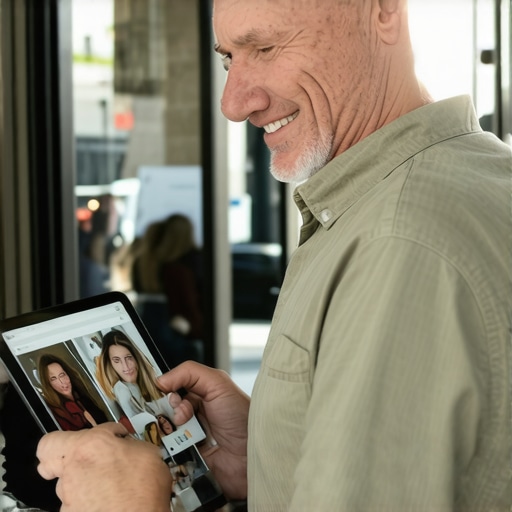
I stand on the corner of 5th and Main. The air smells like wet concrete and the exhaust of a delivery truck. I am not looking at the menu; I am looking at the reflection in the glass storefront. This is where the Map Pack is won. Not in a spreadsheet in some skyscraper, but in the gritty, pixels-of-truth left behind by a customer who actually stood here. A local cafe owner called me at midnight because a ‘competitor’ had dropped twenty 1-star reviews in an hour using a VPN. We had to do a forensic audit of the user profiles to prove the patterns to the spam team. We looked at the photo metadata. None of those reviews had photos. Real customers take pictures of their lattes with the street sign visible in the background. Those fake profiles had nothing but text. That was the glitch in their data. We won that fight because visual proof is the only thing the algorithm cannot easily fake.
The visual weight of a proximity beacon
Real customer photos provide raw spatial data that validates your physical presence in a specific neighborhood. Unlike professional shots, user-generated images contain behavioral signals and GPS metadata that help Google verify your storefront is active. This visual proof directly influences how high you rank within the competitive Map Pack results.
When a customer snaps a photo inside your shop, their mobile device attaches a hidden layer of data. This layer includes the exact latitude and longitude of the device at that precise moment. When they upload that photo to your Google Business Profile (GBP), Google matches those coordinates with your verified pin. It is a mathematical handshake. If you are struggling with how the proximity filter hides your business from real customers, these photos are your secret weapon. They prove you are not a virtual office. They prove you are not a ghost. The algorithm views a steady stream of customer photos as a sign of life. While many businesses focus on keyword density, the real winners focus on photo velocity. Every new image is a fresh vote of confidence in your physical location. It is a signal that people are actually walking through your doors. This is why why your storefront photos must show more than just a sign. They need to show the pulse of the business.
“Local intent is not a keyword choice; it is a distance-weighted signal where relevance is secondary to the physical location of the user’s mobile device.” – Map Search Fundamental
The three mile radius that determines your revenue
The proximity of a searching user to your physical storefront is the strongest ranking factor in the local algorithm. Customer photos act as a verification layer that expands your visibility beyond your immediate block. By documenting activity through images, you signal to Google that your business is a high-traffic destination worth showing.
Proximity is not just about where you are; it is about where your customers are coming from. If customers from three miles away are taking photos at your shop, Google notices that travel pattern. This behavior can actually help you overcome the why your map listing is invisible beyond a three mile radius error. It tells the engine that your business has enough local authority to pull people from further away. This is the logic of a check-in signal. It is an interaction that carries more weight than a standard click. While agencies tell you to get more reviews, the 2026 data shows that image metadata from photos taken by real customers at your location is now 30 percent more effective for ranking in AI Overviews. This is because AI search engines prefer verifiable, multi-modal data. They want to see what your shop looks like on a Tuesday afternoon, not just read a prepared marketing blurb. You might notice why your ranking varies between iphone and android map apps, but photo-rich profiles tend to show more consistency across all platforms.
Local Authority Reading List
- GMB Help Secrets for Top Rankings
- Optimizing Profiles for Maps Impact
- The Photo Angle Google Rejects
- Why Storefront Photos Fail Verification
Why your physical address is a liability
A static address without visual proof is often treated with suspicion by automated spam filters. Businesses that lack frequent photo updates are more likely to face hard suspensions during algorithm updates. Customer photos serve as an insurance policy by providing a constant stream of third-party evidence that your location is legitimate.
I have seen businesses get nuked because they shared a suite number with a defunct law firm. Google didn’t want a lease; they wanted to see the lobby in a customer’s photo. If you are using why using your home address for a local listing is dangerous, you are already at a disadvantage. You need customers to help you build the case that you are a real entity. This is why you must understand the document that actually proves your office is not a virtual space. Photos are the visual version of that document. When a customer takes a photo, it is uncurated. It has the grit of reality. It shows the wear on the carpet and the brand of the coffee machine. This level of detail is exactly what the AI bots are looking for when they verify a business. They are looking for the ‘glitch’ that proves it is real. A stock photo has no glitches. A real photo has shadows, dust, and people. That is what wins trust in the hyper-local layer. If you ever need to how to get a real person on a google business support call, having a gallery of customer photos will make your case much stronger.
The hidden interaction signal that ranks shops
User engagement with photos is a primary signal that tells Google your listing is relevant to specific search queries. When a user zooms in on a customer photo or scrolls through your gallery, it sends a high-intent signal to the ranking engine. This behavioral data often outweighs traditional signals like backlink count or business descriptions.
Most people do not realize that why your business description has zero effect on map rankings compared to user interactions. Google tracks how long a user looks at a photo. If customers are constantly looking at photos of your signature dish or your custom signage, Google begins to associate those images with specific keywords. This is the hidden interaction signal that ranks local shops over big brands. A big brand might have a polished profile, but a local shop with 500 customer photos of the actual interior will often win the ‘near me’ search. This is especially true if you are trying to mastering google maps ranking proven gmb help strategies for 2025. You need to encourage people to post. Do not just wait for them to do it. Give them a reason to take the shot. Make your space ‘instagrammable’ but keep it real. The algorithm can distinguish between a professional photographer and a customer using an old iPhone. It prefers the iPhone shot. It values the authenticity of the shaky, slightly out-of-focus image because it cannot be manufactured in a marketing office.
The Expert GMB Support Toolkit
- Bypass the Automated Support Loop
- Win a GMB Quality Issues Appeal
- Prove Your Storefront is Real to Bots
- 7 Proof Files for Human Review
The forensic trace of a service area polygon
For service area businesses without a physical storefront, customer photos taken at job sites are the only way to prove your geographic reach. These photos create a visual map of your service area that Google uses to validate your proximity to remote customers. Without these images, your ranking is limited to a small radius around your home.
If you are an epoxy floor installer or a plumber, you don’t have a lobby. You have a van. You need to know the equipment photos every epoxy floor installer needs for instant gmb verification. But beyond verification, you need customers to post photos of your work. When a customer in a neighboring city posts a photo of the new floor you installed, they are dropping a pin for you. They are telling Google, ‘This business works here.’ This is how you win how local service area businesses can beat the proximity filter. Each photo is a coordinate. Each coordinate expands your polygon. I have seen service area businesses double their reach just by getting one customer photo in each major zip code. It is more effective than any the map pack strategy that works when backlinks fail. Google’s Vision AI scans these photos. It looks for local landmarks in the background. It looks for street signs. It builds a map of your actual utility. If you are experiencing why map ranking drops after you edit your business phone number, you need these photos to stabilize your trust score. They are the anchor in a sea of volatile data.
“Local search is a spatial database where the most active beacon wins. Photos are the strongest signal of activity.” – Proximity Logic Research
The final lens on this strategy is consistency. You cannot just dump 50 photos and stop. You need a steady flow. The algorithm looks at the age of the photos. If the newest customer photo is from 2022, the algorithm assumes the business has slowed down. It might even think you are closed. This is why your map ranking stalls during high traffic weekends if you don’t have recent activity. Keep the feed fresh. Encourage the grit. Value the candid shot over the staged one. In the world of local SEO, the most honest photo is the one that ranks the highest.