
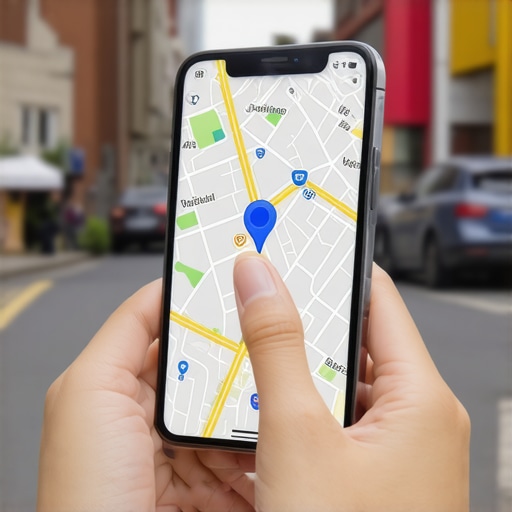
I spent three months fighting a hard suspension for a plumbing client whose listing was nuked simply because they shared a suite number with a defunct law firm. Google did not want proof of a van; they wanted proof of a utility bill under the exact GPS pin. The Logistics Manager in me saw the disaster unfolding. If the pin is off by even twenty feet, the dispatch flow fails. Customers end up in the wrong parking lot. Drivers get frustrated. Most importantly, the proximity engine that Google uses to calculate local relevance starts to decay. You are not just a point on a map; you are a coordinate in a spatial database that values accuracy above all else.
The ghost in the GPS coordinates
To fix a map pin that points to the wrong building, you must navigate to the Edit Profile section of your Google Business Profile and select the Business Information tab. Under the Location section, you can manually drag the pin to the precise rooftop coordinate where your entrance exists. This action resets the latitude and longitude data stored in the Google Maps cache. Precise placement is essential because the algorithm uses these coordinates to calculate the proximity signal for every local search query. If your pin is stuck on a neighboring building, you are effectively telling the engine that you do not occupy your physical space. This mismatch triggers a distrust signal. It often leads to a soft 404 or a duplicate content issue if another business is already verified at that specific coordinate. You need a local seo toolkit for google maps ranking that understands these spatial nuances. I have seen businesses lose thirty percent of their call volume because their pin migrated to the back alley where no one can find the front door. The map pin is the physical anchor of your digital existence. When it drifts, your revenue drifts with it.
“Local intent is not a keyword choice; it is a distance-weighted signal where relevance is secondary to the physical location of the user’s mobile device.” – Map Search Fundamental
The three mile radius that determines your revenue
The proximity radius of a Google Business Profile determines which users see your listing based on their physical distance from your verified GPS coordinates. Google uses a concept called the centroid to establish the heart of a service area. When your pin is misplaced, the entire radius shifts. This shift can push your business out of a high-value neighborhood and into a less profitable zone. I have audited hundreds of profiles where the owner complained that why your map listing is invisible beyond a three mile radius was their primary struggle. Often, the culprit was a pin that had been automatically moved by a user edit or a data refresh from a third party aggregator. You must understand that Google constantly cross-references your pin location with satellite imagery and street view data. If the AI sees a sign for a different business at your coordinates, it will move your pin without asking. This is why the specific storefront signage google demands for fast verification is so vital. It provides the visual proof needed to lock that pin in place. Every foot of distance from the searcher decreases your probability of appearing in the Map Pack. The logistics of search are cold and mathematical. You cannot argue with a coordinate; you can only correct it.
Why your physical address is a liability
A physical address becomes a liability when it is shared with multiple entities or located in a dense urban complex where GPS signals overlap. In these environments, Google struggle to distinguish one suite from another. If you are in a shared workspace, you are at risk. I have seen listings vanish because a neighbor used the same floor number. You must learn how to prove a shared office is a real physical location to avoid being filtered out of the results. The engine prefers unique, standalone structures. When you share a roof, you share the risk of a proximity filter. This filter is designed to prevent a single building from dominating the search results with ten different locksmiths. If your pin is on the wrong building, you might accidentally be triggering this filter against yourself. You are fighting for space in a crowded digital landscape. Your local seo services to clean up old or closed locations must include a deep dive into the historical data of your building. If a spammy business lived there before you, their ghost might still be haunting your coordinates. You need to purge that data to give your own pin a clean slate.
Local Authority Reading List
- Fixing a stuck map pin
- Verification through utility bills
- Category choice impacts
- Resetting stuck verifications
- Second location risks
The logic of a check in signal
A check in signal occurs when a user’s mobile device remains stationary at your business coordinates for a specific duration of time. This behavioral data is one of the most powerful hidden ranking factors in the 2025 algorithm. Google tracks the flow of humans into your building. If your pin is on the wrong building, Google sees people walking past your digital location but never entering it. This creates a high bounce rate in the physical world. The engine concludes that your business is either closed or irrelevant to the search query. This is why why most gmb ranking software fails to account for real world traffic signals is a common complaint among pros. You need people to actually arrive at the pin. If the navigation sends them to the wrong building, you lose the visit and the ranking signal simultaneously. I always recommend that clients use how to use real customer photos to boost your local visibility by encouraging visitors to take photos at the entrance. These photos contain metadata with GPS tags. When those tags match your pin, the ranking jumps. It is a forensic trace of a real human interaction. You cannot fake the physics of a mobile device standing at a specific latitude.
The forensic trace of a service area
Service area businesses must define their boundaries through zip codes and city names rather than a single map pin to avoid proximity traps. If you do not see customers at your location, your pin should be hidden. However, the backend coordinate still matters. Google uses your home or office address as the starting point for your service circle. If that starting point is inaccurate, your reach is compromised. I have seen why your service area map looks tiny to users because the base coordinate was set in a cornfield instead of a city center. You need to find gmb categories and keywords that align with the areas you actually serve. The logistics manager knows that travel time is money. Google knows this too. It will not show a plumber from thirty miles away if there is one two miles away. If your pin is in the wrong place, you are effectively telling the system you are further away than you really are. This is a fatal error in a world where why your maps proximity shrinks right after typical business hours is a documented phenomenon. You need every inch of proximity you can get.
“Relevance is a calculation of distance divided by the probability of a successful user interaction.” – Location Intelligence Whitepaper
The three ways to force a human review
Forcing a human review requires submitting a specific set of documents including a high resolution video walk through and a matching utility bill. The automated bots are often the reason your pin will not move. They see a conflict in the data and they freeze. To break the loop, you must provide evidence that the bot cannot ignore. This includes the document that actually proves your office is not a virtual space. I have spent countless hours recording videos of my clients walking from the street, past the signage, and into the office. You must show the suite number. You must show the light switch. You must show that the space is functional. If the bot rejects you, you must know how to bypass the automated support reply loop every time. It requires a level of persistence that most agencies do not have. They want the easy win. I want the accurate pin. The gmb spam fighting and review cleanup services I provide are built on this foundation of forensic proof. We do not just ask for a change; we demand it with data. If your gmb review and reputation management toolkit does not include a process for manual appeals, you are leaving your ranking to a coin flip. Success in local SEO is a war of attrition against the algorithm’s desire for simplicity.