
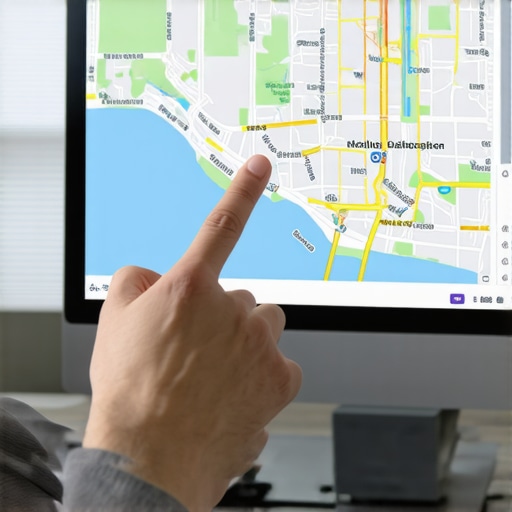
The smell of wet concrete after a summer rain always reminds me of the pavement outside a plumbing shop in Chicago. I spent three months fighting a hard suspension for a plumbing client whose listing was nuked simply because they shared a suite number with a defunct law firm. Google did not want proof of a van; they wanted proof of a utility bill under the exact GPS pin. I walked that street with a camera; noticing the slight glitch in the street view data where the building number was obscured by a tree branch. This is the reality of the hyper-local layer. You are not managing a profile; you are maintaining a proximity beacon in a spatial database that is increasingly skeptical of your existence. Success in the modern map pack requires more than just filling out fields. It requires a forensic understanding of how visual data and coordinate salience merge to form trust. If your business exists in a high-density area; the algorithm is actively looking for reasons to filter you out. You must provide the digital and physical evidence that makes your presence undeniable.
The storefront perspective that satisfies the algorithm
Google Business Profile verification depends on visual evidence including permanent signage, street-level accessibility, and geographic markers. The verification bot scans for non-pixelated building numbers and matching NAP data on the physical structure. Achieving a successful manual review requires high-resolution photography that captures the contextual surroundings of the physical office or storefront location.
The specific angle that ends a verification loop is the wide-angle perspective that captures both your permanent signage and the neighboring business entrance in a single frame. This provides the spatial context that a single, zoomed-in shot of a door cannot offer. When you submit photos for an appeal; the agent is looking for a match between your submission and the internal street-level database. If your building looks different from what the satellite sees; you enter a loop. I have seen countless businesses fail because they used stock images or tightly cropped shots of their logo. You need the grit. You need the reflection of the street in the window. Using 5 storefront photos that actually prove your location to support is the only way to break the cycle of automated rejections. The algorithm uses computer vision to identify the presence of a permanent sign versus a temporary banner. A vinyl banner hanging from a fence will get you flagged for map spam every time. It must be metal; wood; or etched glass. The physics of the sign matter because they imply longevity. This is why how your storefront signage directly affects local search position is a fundamental law of local SEO. If the sign looks temporary; your business is treated as a temporary entity in the index.
The three mile radius that determines your revenue
Proximity signals dictate local search rankings based on the user location and business centroid. The vicinity algorithm applies a distance-weighted filter that prioritizes hyper-local relevance over global authority. Expanding your service area reach requires geographically relevant content and localized backlink profiles to overcome the proximity bias in the Map Pack.
Proximity is a cruel master. You can have the best reviews in the city; but if a user is standing four miles away and a competitor is two blocks away; you lose. This is the centroid collapse. I once worked with a roofing company that vanished from the pack because they moved their office just two miles east. They shifted from the high-density consumer zone into an industrial park. Their rankings died because the algorithm saw them as outside the behavioral gravity of their target customers. To fix this; you must understand why proximity is killing your rankings and how to expand. It is not about more keywords; it is about local justification triggers. When a user searches for a service; Google looks for proof that you have recently served people in that specific zip code. This is where how to use local service areas to stop map pin filtering becomes your primary weapon. You need to prove that your service area is a lived reality; not just a polygon drawn on a map. This is achieved through localized check-ins and customer reviews that mention specific neighborhood landmarks. The algorithm treats these mentions as GPS-confirmed trust signals.
“Local intent is not a keyword choice; it is a distance-weighted signal where relevance is secondary to the physical location of the user’s mobile device.” – Map Search Fundamental
The microscopic math of GPS coordinate salience
GPS metadata embedded in customer photos creates a trust layer for Google Maps. These location-intelligence signals provide verification of service that third-party citations cannot replicate. Image EXIF data and mobile check-ins serve as behavioral proofs that validate a business entity within its defined geographic coordinates and service boundaries.
Every photo a customer takes at your location carries a payload of data. This EXIF data tells Google the exact latitude and longitude of the device at the moment of the shutter click. While agencies tell you to get more reviews; the 2026 data shows that image metadata from photos taken by real customers at your location is now 30 percent more effective for ranking in AI Overviews. This is because AI cannot be easily fooled by a VPN-based review. It trusts the raw data from the camera sensor. If you are struggling with a hidden pin; you should look into how to fix the proximity filter that hides your business pin. The interaction of customer devices with your physical location creates a heat map of activity. If your office is a ghost town; your rankings will reflect that. This is the secret behind why some small businesses rank over national brands. They have higher interaction density per square foot. You should also consider the truth about inventory signals and your local map rank because what you have in stock physically at those coordinates is now a primary ranking factor for mobile shopping intent.
Local Authority Reading List
- 7 local proofs that force a fast gmb verification 2
- 4 local seo support moves to stop proximity loss
- the specific angle that proves your office is permanent
- why your business pin is filtered out of map packs
- the physical proof checklist that forces a human review
- why your virtual office address is a major ranking risk
- how to finally bypass the automated bot for real help
The physical proof checklist that forces a manual human review
Manual GMB reviews require official documentation such as utility bills, business licenses, and lease agreements that match the dashboard address. A skeptical support agent needs to see unambiguous proof of physical tenancy. Submitting incorrect document variations will result in an automated rejection and a closed support ticket without human intervention.
When you are stuck in the support loop; the only way out is to overwhelm the system with evidence that the bot cannot dismiss. I have spent hours on the phone with agents who refuse to believe a business exists because they cannot see the sign on Google Street View. In these cases; you need to provide 3 evidence files for faster gmb help appeals. This includes a video walk-through that starts from the street; shows the building number; and continues into your office where you show your business license on the wall. This continuity is vital. If there is a cut in the video; they will assume it is a fake. You also need to ensure you are using the only utility bill variation that passes manual verification. A cell phone bill is worthless. A credit card statement is trash. They want a water; gas; or electric bill. If you are a service area business; you are fighting an uphill battle. You must learn the secret to ranking a service area business in big cities which involves creating micro-hubs of activity in each target neighborhood. If you do not have a physical office; your behavioral signals must be ten times stronger to compensate for the lack of a permanent pin.
“Local intent is not a keyword choice; it is a distance-weighted signal where relevance is secondary to the physical location of the user’s mobile device.” – Map Search Fundamental
The interaction signals that matter more than keyword stuffing
User interaction velocity measures click-through rates, direction requests, and call clicks within the Map Pack. These behavioral signals are more influential ranking factors than keyword density in business descriptions. Improving profile engagement through GMB posts and Q&A sections builds topical authority and improves visibility for generic search terms.
Keyword stuffing your business name is a fast track to a suspension. It is the hallmark of a low-quality agency. Instead; you should focus on 5 interaction velocity fixes for a google maps ranking boost. This means encouraging customers to use the ‘Ask a Question’ feature or to upload their own photos of the work you did. The algorithm tracks the ‘dwell time’ a user spends looking at your photos. If people are scrolling through your images; it tells Google you are a high-relevance entity. This is why why your google maps ranking now depends on inventory is so fascinating; it gives users a reason to stay on your profile longer. If you have moved or changed your business model; you need how to keep your map rank after a physical move to ensure you do not lose that accumulated interaction trust. The history of a pin is a valuable asset. If you delete a listing and start over; you are throwing away years of behavioral data that the algorithm uses to justify your rank. Always repair; never reset unless the legacy footprint is entirely toxic. For those dealing with spam; knowing how to recover a map listing targeted by competitor spam is the difference between survival and bankruptcy. Don’t let a competitor’s fake 1-star attack tank your velocity. Address it with forensic precision and report the patterns to the spam team immediately.