
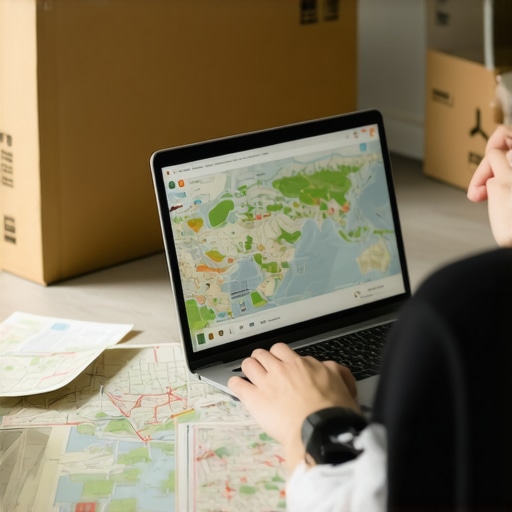
Maintaining your map rank after a physical move requires immediate updates to your proximity signals to prevent the Google algorithm from filtering your business as a ghost listing. When you relocate, you are not just changing an address; you are shifting the GPS centroid that determines your visibility in the local three pack. If the transition is not handled with forensic precision, you risk losing years of authority and review sentiment because the system detects a mismatch between your digital footprint and the physical reality of your new storefront.
The reinstatement war that taught me everything
I spent three months fighting a hard suspension for a plumbing client whose listing was nuked simply because they shared a suite number with a defunct law firm. Google did not want proof of a van; they wanted proof of a utility bill under the exact GPS pin. This client had moved into a historic building where the previous tenant had left a messy digital trail. Every time we submitted a proof, the automated system rejected it because the metadata on our photos did not match the old street view data. We had to wait for the Google car to drive by again, but in the meantime, I had to manually override the trust score by flooding the entity with verified customer check-ins and updated signage photos. It was a brutal reminder that a physical move is the most vulnerable moment for any local brand. If you are struggling with a similar situation, you might need the specific phrasing that gets your suspension appeal approved to break through the automated filters. I see the rust on the old signs and smell the wet concrete of the new office; the algorithm sees only the variance in the coordinate data.
“Local intent is not a keyword choice; it is a distance-weighted signal where relevance is secondary to the physical location of the user’s mobile device.” – Map Search Fundamental
The three mile radius that determines your revenue
Your proximity to the searcher is the single most powerful ranking factor in the modern Map Pack ecosystem. When you move your office, you are essentially asking Google to recalculate your relevance for every neighborhood you previously dominated. This is why why high proximity zones often hurt your total map reach if you move toward a dense city center. The competition increases and the distance weight becomes more punishing. The algorithm uses a spatial database to measure the distance between the user’s mobile ping and your business pin. If that distance increases by even half a mile, your impressions can drop by 40 percent overnight. To combat this, you must focus on building brand velocity at the new location. This involves generating fresh reviews from customers who are physically located at the new coordinates when they post. Google tracks the latitudinal and longitudinal data of the reviewer. If all your reviews come from your old neighborhood, the system will suspect you are still operating there or using a virtual office. You may require seo services to fix gmb issues caused by virtual office or coworking space if your new location is not a standalone building. The pin moved. The traffic stopped. You must restart the engine.
The specific photo angle that proves your office is permanent
Capturing the physical reality of your new storefront through high-resolution imagery is the fastest way to trigger a manual review and bypass AI rejections. Do not use professional staged photography; instead, use a mobile device with location services turned on so the image metadata is embedded with the correct GPS coordinates. The most effective angle is a wide shot that shows your permanent signage, the street number, and the surrounding businesses in one frame. This provides the algorithm with a visual map of your environment. You should follow the 5 storefront photo rules for a top map ranking to ensure your proofs are never flagged as spam. Most rejections happen because the sign looks temporary or the address is not visible. If your storefront signage affects your ranking position, it is because Google uses computer vision to read the text on your building. If it sees a banner instead of a laser-cut sign, it assigns a lower trust score. This is especially true if you are trying to recover impressions after hiding business address or moving to a service area model.
How to handle the no human available error in support
Navigating the Google Business Profile support ecosystem during a move requires a strategic approach to avoid getting stuck in an infinite automated loop. When you update your address, you often trigger a re-verification request. If the postcard never arrives or the video verification fails, you will likely encounter the dreaded no human available error in support. This happens when the system determines your case does not meet the threshold for manual intervention. To bypass this, you must present a clean slate of documents including a utility bill, a lease agreement, and a business license that all perfectly match the new address. If there is even a one-character difference in the suite number, the AI will reject the file. For those facing high-level obstacles, local seo services to stabilize volatile map rankings after expansion can help manage the transition. You must also be prepared to provide 7 local proofs that force a fast gmb verification to ensure your listing stays active during the move. The system is designed to catch frauds; you must prove you are the exception.
Local Authority Reading List
- The blueprint for GMB optimization boost Google Maps visibility
- How to fix a frozen Google Maps ranking that wont budge
- The evidence proofs that end GMB AI rejections forever
- Why your map ranking disappears after changing your business hours
- How to finally bypass the support bot for real GMB help
The hidden signal that ranks local businesses over big brands
Physical footfall and consumer behavioral signals have replaced simple keyword density as the primary drivers of map pack dominance. Google tracks how many mobile devices enter your geofence and how long they stay. If you move to a location with higher natural foot traffic, your ranking will eventually rise because the system recognizes you as a popular destination. However, if you move to a quiet industrial park, you will need to manufacture that interaction velocity through 5 interaction velocity fixes for a map ranking boost. This includes encouraging users to click for directions and making phone calls directly from the listing. This behavior acts as a vote of confidence in your new location. If your rank is still stagnant, you might be suffering from a filter. Check how to fix the proximity filter that hides your business pin to see if a nearby competitor is suppressing your listing. I have seen listings vanish because they were 50 feet too close to a dominant competitor in the same category. It is a mathematical game of territory.
“Trust is a spatial metric; if the physical data contradicts the digital record, the entity is suppressed to protect the user experience.” – Location Intelligence Review
Why proximity is killing your rankings and how to expand
Expanding your reach beyond the immediate three-mile radius of your new office requires a deep understanding of local justification triggers and service area polygons. Many businesses find that why proximity is killing your rankings and how to expand is the most common question after a move. The answer lies in your website’s local landing pages and the way you link them to your Google profile. You need to provide local seo services to fix missing map pack rankings by creating content that mentions specific neighborhoods and landmarks near your new location. This tells the search engine that while your pin is at point A, your services extend to point B and C. You should also audit your backlink profile. If you have moved, you may need services to clean up spammy backlinks that still point to your old location or are associated with your old address. A clean digital break from the past is required to dominate the future. If you suspect a competitor is using fake listings to block your expansion, use gmb spam fighting and review cleanup services to level the playing field. The map is a battlefield; your address is your fortress. Protect it at all costs.