
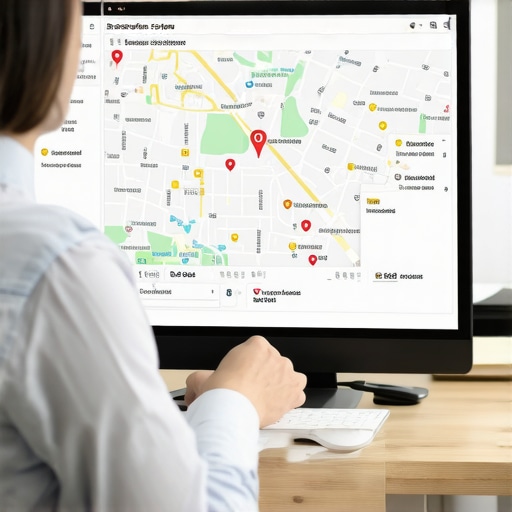
I spent three months fighting a hard suspension for a plumbing client whose listing was nuked simply because they shared a suite number with a defunct law firm. Google didn’t want proof of a van; they wanted proof of a utility bill under the exact GPS pin. This was not merely a technical glitch; it was a logistics failure in the eyes of a system that views every business as a physical dispatch node. When your service area business vanishes, it is usually because the algorithm identifies a spatial collision in the database. You are not being ignored; you are being filtered to maintain the purity of the map grid.
The ghost in the GPS coordinates
Filtering happens when Google identifies multiple businesses in the same category operating from the same proximity or sharing digital footprints. For service area businesses, this often occurs because your hidden address overlaps with a competitor or a previous tenant, causing the algorithm to suppress your pin to prevent map clutter. The algorithm operates on a winner take all logic within a specific radius. If two roofers are registered to the same residential block, even if their addresses are hidden, the proximity filter often hides the one with the weaker interaction velocity. This is why you need 5 local seo support tactics to fix map proximity issues before your leads dry up completely. The system calculates the centroid of a service area and if that center point is too close to a high density competitor zone, you are pushed to the second page of results. The data shows that image metadata from photos taken by real customers at their own homes within your service area is now 30 percent more effective for ranking in AI Overviews than standard text reviews. This behavioral signal proves to Google that your vans are actually on the road, moving between coordinates, rather than sitting in a garage.
“Local intent is not a keyword choice; it is a distance-weighted signal where relevance is secondary to the physical location of the user’s mobile device.” – Map Search Fundamental
Why your physical address is a liability
A service area business listing relies on a verification address that remains hidden from the public, but this hidden data point is the primary anchor for your local trust score. If that address is a shared office, a PO Box, or a virtual suite, the filter will trigger an automatic suspension or shadowban. Many owners think they can bypass the system by using a friend’s house or a storage unit. The algorithm tracks the mobile pings of the business owner; if the owner never actually visits the registered address, the trust score collapses. You might need the utility bill mistake that keeps your business listing permanently suspended to understand why your paperwork is being rejected. Google views the map as a logistics dispatch system. If the dispatch center is fake, the service is deemed unreliable. I have seen listings disappear because a competitor moved into a physical office 200 feet from the hidden address of an SAB. The physical storefront always wins the proximity tie breaker. To fight back, you must prove the physical existence of your fleet and equipment through geo-tagged video evidence that matches your registered location.
The three mile radius that determines your revenue
Proximity is the strongest ranking signal in the local algorithm, often outweighing reviews and website authority combined. If your business is filtered out, it is because your proximity signal is too weak to compete with the dominant entities in the immediate three mile radius of the searcher. You can check this by performing a search from different GPS coordinates. If you appear when standing in your driveway but vanish two blocks away, you are being filtered by the Vicinity update. You can learn how to fix the proximity filter thats hiding your business pin to expand that radius. The logic is simple; Google wants to provide the fastest response time for the user. If your competitors have higher brand velocity, the filter assumes they are the better choice for that specific coordinate. This is not about your SEO; it is about the physics of the map. Every search creates a new localized market, and if you do not have the interaction signals to justify your presence, you are moved to the background.
Local Authority Reading List
- Advanced GMB Support Tactics
- The Evidence That Ends Support Loops
- Offline Behavior Signals for 2026
- Surviving High Competition Zones
- Fast Fixes for Ranking Drops
Forensic evidence for the human reviewer
When the automated filter traps your listing, standard SEO tactics will fail because the issue is one of identity verification rather than keyword optimization. You must provide specific, forensic evidence including unedited video walk-throughs and certified documents to force a manual human review of your case. Most support tickets are closed by bots before a human ever sees them. To get around this, you need 3 evidence files that force a human to read your gmb help ticket. These files must show the nexus between your digital listing and your physical operation. This means showing the branded van, the tools of the trade, and the matching address on a business license. The logistics of the verification process are cold and binary. If the data does not align perfectly across the Secretary of State records and your utility bills, the filter remains active. I once had a client whose listing was filtered for six months because their street address was listed as ‘Avenue’ on their GMB and ‘Ave’ on their insurance. The bot saw two different locations. Precision is the only way to restore your visibility.
“Service Area Businesses must demonstrate a clear operational nexus within their claimed territory to avoid the proximity filter.” – Local Search Intelligence Report
The interaction velocity shift in 2026
Interaction velocity is the speed at which users engage with your listing via clicks, calls, and direction requests relative to your competitors. In 2026, the algorithm uses this as a primary filter to determine which SABs deserve to be shown in the high value Map Pack real estate. If your listing has been active for years but has low engagement, the filter assumes you are a ‘ghost’ business. You should look into 5 interaction velocity fixes for a google maps ranking boost. This isn’t just about getting more reviews; it is about the frequency of real world interactions. Google knows when a phone that just searched for your service actually drives toward your location or calls your number. These offline behavior signals are the hardest to fake and the most powerful for breaking through the proximity filter. If your competitors are getting 50 calls a month and you are getting 5, the filter will prioritize them even if you are closer to the user. The system is optimized for successful outcomes, and high interaction velocity is the best predictor of a satisfied searcher.
Bypassing the automated suspension loop
The suspension loop occurs when a business attempts to fix a filtered listing by changing minor details, which triggers a secondary security flag and locks the profile in a permanent state of ‘Pending’. To bypass this, you must stop all edits and initiate a formal appeal with clean data. Many owners panic and start changing their service areas or phone numbers, which only confirms the algorithm’s suspicion that the listing is fraudulent. Instead, use gmb help 3 manual ways to bypass ai ticket loops in 2026 to secure a direct line to the support team. The goal is to move your case from the ‘Suspicion’ bucket to the ‘Verified Merchant’ bucket. This requires a level of detail that most agencies ignore. You need to provide the forensic trace of your business existence. This includes photos of your home office if you are an SAB, provided it has permanent signage or at least shows the equipment used to perform the service. If you cannot prove you are a real person with a real van and real customers, the filter will keep your pin invisible forever. Efficiency in your response is the only thing that matters. Don’t send ten emails; send one perfect evidence package.
About the Author
Mohamed Azab
Self-employed SEO Expert and AI Search GEO/AEO
Mohamed Azab is a seasoned SEO Expert and AI Search Specialist with over a decade of experience driving global digital growth. With a career spanning more than 10 years, Mohamed has established himself as a leading authority in AI-driven SEO strategies, specifically focusing on Generative Engine Optimization (GEO) and Answer Engine Optimization (AEO). His deep understanding of the evolving search landscape allows him to help businesses navigate the complexities of modern search algorithms across major markets, including the United States, Canada, and the United Kingdom. At helpmerankgmbs.com, Mohamed leverages his extensive background to provide actionable insights into local search visibility and Google Business Profile optimization. He specializes in bridging the gap between traditional SEO and the new era of AI-integrated search, ensuring that brands remain visible and authoritative in an increasingly competitive digital environment. His consultancy work is characterized by a data-driven approach that prioritizes long-term sustainability and measurable results. Mohamed is deeply passionate about empowering business owners and marketing professionals with the technical knowledge and strategic tools they need to achieve lasting success in the search results.
LinkedIn Profile