
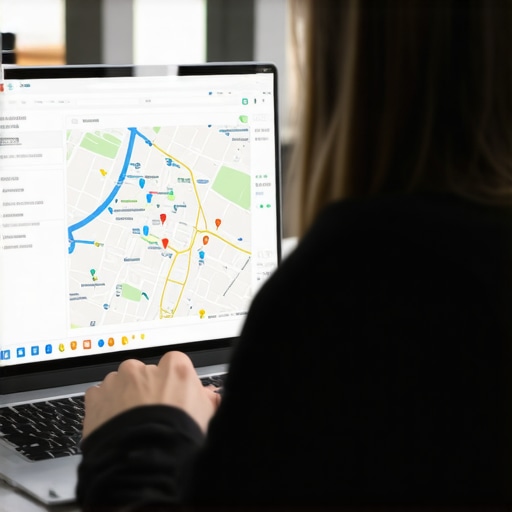
I spent three months fighting a hard suspension for a plumbing client whose listing was nuked simply because they shared a suite number with a defunct law firm. Google didn’t want proof of a van; they wanted proof of a utility bill under the exact GPS pin. This was not a clerical error; it was a proximity execution. The algorithm decided the building was already occupied by a similar category and erased my client to reduce clutter. I had to prove that the plumber owned every square inch of that suite with timestamped video and a lease that matched the tax records. That is the reality of the local search war today.
The ghost in the GPS coordinates
The proximity filter is a distance-weighted algorithm that suppresses redundant business listings in high-density areas. To fix a hidden business pin, you must strengthen your entity authority, resolve address overlaps, and prove your physical presence through verified location signals like geocoded photos and local utility bills. The map pack does not have infinite space. When two businesses in the same category sit too close together, Google hides one. It is a mathematical cull. You might think your google maps ranking is safe because you have reviews, but if your neighbor has a stronger centroid signal, you are invisible. This is the spatial filter at work. It smells like peppermint in my office when I pore over these data maps, but the reality for most owners is the cold scent of a dead phone line. Maps are math. The pin moved because the algorithm found a more authoritative coordinate.
“Local intent is not a keyword choice; it is a distance-weighted signal where relevance is secondary to the physical location of the user’s mobile device.” – Map Search Fundamental
Why your physical address is a liability
A shared office or a hidden suite number can trigger an immediate proximity filter that removes your business from the local results. Google prioritizes unique physical footprints and often suppresses listings that share a tax parcel or building foundation with direct competitors to prevent map spam. You cannot hide behind a virtual mailbox anymore. The system identifies the footprint of the building. If a national chain sits on the first floor and you are on the fourth, your seo support needs to emphasize your unique entrance. I see small merchants get crushed by national brands every day. It is a disgrace. To fight back, you need to provide the physical proof checklist that forces a human gmb review to show you are a distinct entity. The algorithm is lazy; it groups pins to save processing power. You must force it to see you as a separate beacon. Use the the one utility bill variation that gmb support actually accepts to anchor your location in the database.
The three mile radius that determines your revenue
The local search radius is shrinking as mobile density increases, making it harder for businesses to rank outside of their immediate neighborhood. To expand your reach, you must increase your brand velocity and gather reviews from customers located in the specific zip codes you want to target. Your reach is a circle. That circle gets smaller when a competitor opens a shop closer to the city center. This is the physics of the map pack. If your proximity signal is failing, you must use behavioral data to stretch your influence. Real people must travel from their house to your shop. Google tracks this movement. Every check-in is a vote for your relevance. Every time a user opens a map and searches for you by name, your radius expands. This is why brand velocity is the new 2026 google maps ranking signal. It is not about keywords; it is about how many people are willing to drive past your competitor to get to you.
Local Authority Reading List
- 3 Evidence Files That Force a Human Review
- The Hidden Signal for Local Dominance
- 5 Fast Fixes for Ranking Drops
- How to Get a Human GMB Support Agent
- Why Competitors Rank with Fewer Reviews
Forensic signals that override distance
Customer interaction data and image metadata now carry more weight than traditional citations in overcoming the proximity filter. When users upload photos with embedded GPS coordinates to your profile, Google receives an unshakeable proof of your business location and its popularity within the community. Stop buying dead directory links. They do nothing. Instead, look at your storefront photo rules for a top google maps ranking. The algorithm analyzes the pixels. It looks for your signage. If your sign is not permanent, you are a ghost. I have seen listings survive a filter simply because they had high-quality video evidence. You can fix your google maps ranking by showing the interior of your shop in a single, unedited shot. This proves you exist. It proves you are not a lead-gen scammer in a basement. The offline behavior signals are the only thing that will save you in 2025. People must click. People must call. People must drive.
The way through the algorithm
Bypassing the automated support loop requires specific documentation that proves your business operates at the stated address without ambiguity. Providing a combination of a government-issued business license and a live video walkthrough of the premises is the most effective way to reset a filtered listing. Most gmb help is a waste of time because it is handled by bots. You need to know how to bypass ai ticket loops. The bots look for patterns. If your utility bill has a typo, you are rejected. If your video is too shaky, you are rejected. You must be precise. I once had a client who was filtered for six months because their sign was a vinyl banner instead of metal. The algorithm flagged it as temporary. We had to install a permanent monument sign and resubmit. Only then did the pin reappear. If you are stuck, you might need advanced gmb support tactics to break the cycle. The filter is not a mistake; it is a gate. You need the right key to open it.
“Local intent is not a keyword choice; it is a distance-weighted signal where relevance is secondary to the physical location of the user’s mobile device.” – Map Search Fundamental
About the Author
Mohamed Azab
Self-employed SEO Expert and AI Search GEO/AEO
Mohamed Azab is a seasoned SEO Expert and AI Search Specialist with over a decade of experience driving global digital growth. With a career spanning more than 10 years, Mohamed has established himself as a leading authority in AI-driven SEO strategies, specifically focusing on Generative Engine Optimization (GEO) and Answer Engine Optimization (AEO). His deep understanding of the evolving search landscape allows him to help businesses navigate the complexities of modern search algorithms across major markets, including the United States, Canada, and the United Kingdom. At helpmerankgmbs.com, Mohamed leverages his extensive background to provide actionable insights into local search visibility and Google Business Profile optimization. He specializes in bridging the gap between traditional SEO and the new era of AI-integrated search, ensuring that brands remain visible and authoritative in an increasingly competitive digital environment. His consultancy work is characterized by a data-driven approach that prioritizes long-term sustainability and measurable results. Mohamed is deeply passionate about empowering business owners and marketing professionals with the technical knowledge and strategic tools they need to achieve lasting success in the search results.
LinkedIn Profile