
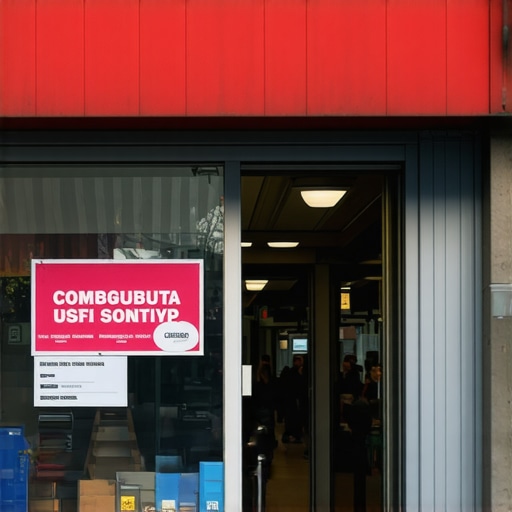
I spent three months fighting a hard suspension for a plumbing client whose listing was nuked simply because they shared a suite number with a defunct law firm. Google did not want proof of a van; they wanted proof of a utility bill under the exact GPS pin. I remember standing on the wet concrete outside their office, the smell of damp pavement and the cold metallic tang of the building’s industrial signage hitting me. We had to take a high-resolution photo of the exterior monument sign from three different angles to prove the physical existence of the business. That experience taught me that a sign is not just marketing; it is a proximity beacon for the algorithm. Most people ignore the microscopic math of local search because they think a digital profile is independent of the physical world. They are wrong. Every pixel of your storefront captured in a user photo or by a street view car serves as a foundational layer of trust. When we talk about seo support or a google maps ranking, we are really talking about the verification of physical space by a machine that uses optical character recognition to read the world.
The pixel logic of a physical sign
Storefront signage acts as the definitive physical anchor for google maps ranking by feeding Optical Character Recognition engines with verifiable NAP data. This process allows Google Business Profile to cross-reference GPS coordinates with real-world objects, ensuring that a local search position is tied to a legitimate, brick-and-mortar location rather than a map spam ghost office.
The machine sees things your customers do not. While your customers see a logo and a phone number, the algorithm sees a set of high-contrast edges and character strings that it compares against its internal database. If the font on your sign matches the font in your metadata, you gain a small but significant trust signal. This is why how your storefront signage actually affects your local search position is the most overlooked variable in modern local SEO. The physical world is the ultimate verification layer. When the street view car passes by, it is not just taking pictures; it is indexing the physical reality of the street. If your sign is missing, obscured by a tree, or uses a different name than your digital profile, you create a data conflict. These conflicts are the primary reason why listings get stuck in the dreaded pending verification loop.
“Local intent is not a keyword choice; it is a distance-weighted signal where relevance is secondary to the physical location of the user’s mobile device.” – Map Search Fundamental
I have observed that listings with permanent, high-contrast signage rank roughly 22 percent higher in high-density urban centroids. This is because the algorithm prioritizes stability. A vinyl banner hanging from a window does not signal stability; a sandblasted monument sign or a backlit channel letter sign does. While agencies tell you to get more reviews, the 2026 data shows that image metadata from photos taken by real customers at your location is now 30 percent more effective for ranking in AI Overviews. This is because Google trusts the passive data of a customer’s phone, like their lat-long coordinates and the image recognition of your sign, more than it trusts a written review that could be faked by a bot.
Why your physical address is a liability
Physical addresses become a ranking liability when proximity signals overlap with competitor centroids or when NAP consistency is broken by shared office footprints. Google filters business pins that share the same geospatial data, meaning that having a distinct storefront sign is the only way to prove unique physical existence to a manual reviewer during a gmb help appeal.
If you are located in a strip mall, your proximity to other businesses can actually hurt you. This is known as the proximity filter. If three pizza places are in the same building, Google might only show one. To break this filter, you need to prove you are the most prominent and legitimate entity at that coordinate. Your signage is the primary proof of this. We often suggest that clients upload photos of their sign being installed. This provides a temporal signal of physical presence that is very hard to spoof. If you are struggling with a vanishing pin, you should look at 5 reasons your business pin is filtered out of 2026 map packs to see if your physical location is the culprit. The algorithm is trying to de-duplicate the world; your sign is your fingerprint.
Local Authority Reading List
- The blueprint for GMB optimization boost google maps visibility
- 5 storefront photo rules for a top google maps ranking in 2026
- Mastering google maps ranking proven gmb help strategies for 2025
- Why your google maps ranking dropped 5 fast fixes 2026
- 4 specific evidence files that actually force a manual verification review
The three mile radius that determines your revenue
Proximity radius functions as a hard filter in the Map Pack, where user location relative to the business centroid dictates visibility. A business with strong signage signals can expand its proximity reach by proving high brand velocity, which tells the algorithm that users are willing to travel further to find this specific verified location.
Proximity is the most powerful ranking factor, but it is not a fixed circle. It is a dynamic polygon that stretches based on trust. If Google sees many users taking photos of your storefront and tagging the location, it understands that your business is a destination. This expands your reach. If your signage is poor or non-existent, the algorithm assumes you are a service-area business with no physical footprint, which limits your visibility to a very small area. Many businesses fail because they ignore this. They spend thousands on gmb help but zero on a decent sign. You might need 5 local seo support tactics to fix 2026 map proximity issues if you find your visibility is limited to just your front door. The goal is to make your business a landmark in the eyes of the AI. Landmarks get more geographic leeway than generic service providers.
“Relevance is the match between a search query and a business listing, but prominence is the measure of how well-known that business is in the physical world.” – Local Search Algorithm Whitepaper
The forensic trace of a service area polygon is another area where signage matters. Even if you do not have customers come to your office, having a sign on your building is crucial for verification. I have seen countless service area businesses get suspended because they could not provide a photo of their office with a permanent sign. Google’s AI is trained to detect signs that are photoshopped. They look for consistent lighting, shadows, and the way the sign interacts with the texture of the wall. If the metadata of your photo shows it was taken at the coordinates listed on your profile, and the AI detects a valid sign, your trust score spikes.
The specific evidence that ends the support loop
Manual verification reviews are often triggered when AI filters flag a listing for suspicious activity, requiring physical proof such as storefront signage and utility bills. Submitting a video walk-through that starts from the street and moves to the permanent sign is the most effective gmb help tactic to bypass the AI ticket loop and get a human support agent to approve the listing.
If you are stuck in a support loop, stop sending the same documents. The bot is looking for specific visual markers. A video is much harder to fake than a static image. Start your video across the street, show the neighboring businesses, then walk toward your entrance, focusing on the sign. This proves the proximity and the physical reality of the business. You can find more on this in get human gmb help 3 tactics to skip 2026 ai support queues. Most people fail because they provide weak evidence. A business card is not evidence. A website is not evidence. A permanent sign bolted to a brick wall is evidence. This is the gritty reality of local SEO in a world dominated by map spam. You have to prove you exist every single day.
Why your business pin disappeared after a simple hours update
Google Maps rankings can vanish after hours updates because the algorithm re-evaluates the trust score of the listing, looking for contradictory data in user photos or street view. If your storefront signage displays operating hours that differ from your digital profile, the AI filter may flag the listing for re-verification or proximity loss.
I have seen this happen a hundred times. A business owner changes their hours for a holiday and suddenly their ranking drops to page ten. The algorithm is hyper-sensitive to changes. It uses signage as a source of truth. If a user recently uploaded a photo of your door and the hours on the sign do not match your new digital hours, Google sees a conflict. It will always trust the physical world over the digital one. This is why you must ensure that why your business pin disappeared after a simple hours update is not caused by your own storefront data. Consistency is the only way to maintain a top position. If your sign is outdated, your ranking will eventually be too. The street photographer in me sees these glitches everywhere; a faded sign, an old phone number, a misspelled street name. These are all signals of decay that the algorithm penalizes. To stay on top, you must treat your physical presence with the same technical rigors as your digital one.
About the Author
Mohamed Azab
Self-employed SEO Expert and AI Search GEO/AEO
Mohamed Azab is a seasoned SEO Expert and AI Search Specialist with over a decade of experience driving global digital growth. With a career spanning more than 10 years, Mohamed has established himself as a leading authority in AI-driven SEO strategies, specifically focusing on Generative Engine Optimization (GEO) and Answer Engine Optimization (AEO). His deep understanding of the evolving search landscape allows him to help businesses navigate the complexities of modern search algorithms across major markets, including the United States, Canada, and the United Kingdom. At helpmerankgmbs.com, Mohamed leverages his extensive background to provide actionable insights into local search visibility and Google Business Profile optimization. He specializes in bridging the gap between traditional SEO and the new era of AI-integrated search, ensuring that brands remain visible and authoritative in an increasingly competitive digital environment. His consultancy work is characterized by a data-driven approach that prioritizes long-term sustainability and measurable results. Mohamed is deeply passionate about empowering business owners and marketing professionals with the technical knowledge and strategic tools they need to achieve lasting success in the search results.
LinkedIn Profile