
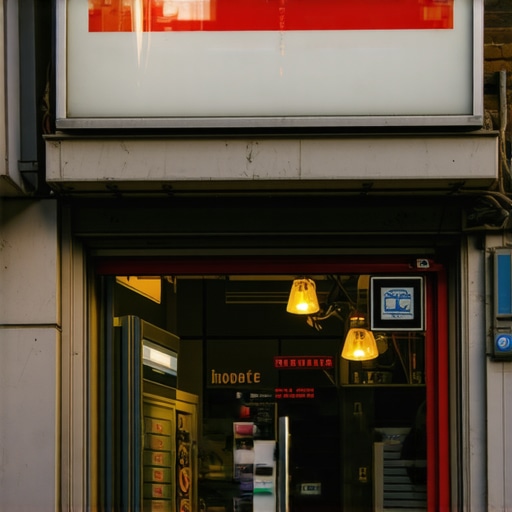
The air smells like wet concrete after a summer storm. I am standing across from a storefront, my camera lens focused on the slight peeling of a vinyl decal. Most people see a sign; I see a data point in a spatial database. My years as a map-spam investigator taught me that Google does not just read your text fields. It reads your world. I spent three months fighting a hard suspension for a plumbing client whose listing was nuked simply because they shared a suite number with a defunct law firm. Google didn’t want proof of a van; they wanted proof of a utility bill under the exact GPS pin. That experience solidified my belief that the physical and digital are inseparable. If your signage is weak, your google maps ranking will eventually reflect that gap in physical reality. We are moving toward a world where the camera is the primary crawler for local entities.
The physical reality of a digital pin
Physical storefront signage acts as a high-confidence verification signal that anchors your business to a specific latitude and longitude. Google uses computer vision to extract text from user-uploaded photos and Street View imagery to confirm your business name and address matches its internal database. This process provides the seo support needed to maintain a high-trust score in the local algorithm. Every time a passerby snaps a photo of your shop, they are performing a micro-audit. The algorithm looks for permanent fixtures. It looks for the consistency of your branding against the digital record. When your sign says one thing and your profile says another, the trust score drops. This is why many businesses seek gmb help when they realize their photos are outdated. A mismatch between your sign and your digital title is a primary trigger for a proximity filter or a manual suspension. The system prefers a gritty, real-world photo over a polished, deceptive render. The lens does not lie.
“Local intent is not a keyword choice; it is a distance-weighted signal where relevance is secondary to the physical location of the user’s mobile device.” – Map Search Fundamental
How computer vision reads your metal signs
Google utilizes Cloud Vision and Optical Character Recognition to scan every photo uploaded to your profile for brand signals and local justifications. This technology detects your business name, phone number, and service keywords directly from your storefront and lobby signage to validate your entity. If you have google maps ranking issues, look at your primary photo. Is the sign clearly visible? Can a machine read the font? I have seen listings jump three spots in the map pack just by replacing a blurry storefront shot with a high-resolution, wide-angle image that shows the sign in relation to the street. This is not about aesthetics; it is about machine-readable proof. When the algorithm sees your name on a physical building, it confirms you are not a lead-generation ghost office. This is why 5 storefront photo rules for a top google maps ranking in 2026 emphasize the importance of permanence. Temporary banners or taped-up paper signs are often ignored or flagged as suspicious by the spam-fighting bots. You need metal, wood, or high-quality vinyl to signal longevity. The algorithm rewards the established brick-and-mortar presence with a wider proximity radius. If the machine cannot verify your sign, it keeps your visibility restricted to your immediate street corner.
The three mile radius that determines your revenue
Your proximity radius is the physical distance from your storefront where your business appears in the top three map results. Signage density and user interaction with your physical location expand this radius by proving you are a prominent local landmark rather than just another listing. Most business owners think they can rank across the whole city from a single office. This is a fallacy. Your visibility is a balloon that expands or contracts based on trust. If your storefront is prominent and frequently photographed, Google recognizes you as a local landmark. Landmarks get more leeway in proximity. This is the hidden math of seo support. If you are struggling with a shrinking visibility zone, you might need to fix the proximity filter thats hiding your business pin. The algorithm analyzes how people move toward your business. If the signage is clear, customers find you faster. If they find you faster, their GPS dwell time at your location confirms the visit. This behavioral loop is more powerful than any backlink. Google tracks the speed at which a user moves from a search to your front door. If your sign is hard to find, they circle the block. That friction is a negative signal. It tells the engine your location data is imprecise or confusing. Clear signs lead to fast check-ins.
Local Authority Reading List
- 5 interaction velocity fixes for a google maps ranking boost 2026
- why physical footfall now controls your 2026 google maps ranking
- 3 offline behavior signals boosting google maps ranking in 2026
- 6 physical proofs that end your gmb help ticket loop in 2026
The forensic proof of a permanent fixture
Permanent signage serves as the ultimate evidence for resolving listing suspensions and verification delays by proving the business exists in a physical capacity. Google’s support teams prioritize video and photo evidence that shows a fixed sign attached to a building over any other documentation. When a listing gets stuck, the first thing I check is the exterior. Is there a sign? Is it permanent? If you are looking for gmb help, you must understand that the human reviewers are trained to look for signs of a ‘virtual office.’ They look for the way the light hits the sign. They look for shadows. They look for the texture of the wall. Fake signs often lack these natural details. If you have a professional sign, take photos from different angles at different times of the day. This provides a multi-dimensional proof of your existence. This level of seo support is what separates the winners from the suspended. I remember a case where a locksmith was denied three times because his ‘sign’ was just a magnet on his van. We had to rent a small workshop and install a permanent sign before Google would allow the listing to go live. The cost of the sign was the best SEO investment he ever made. It wasn’t about the customers seeing it; it was about the algorithm believing it. Without that physical anchor, you are just a ghost in the machine.
“Local search results are increasingly based on the machine’s ability to cross-reference Street View data with user-provided imagery to ensure entity validity.” – Location Intelligence Whitepaper
The relationship between branding and brand velocity
Brand velocity measures how quickly people search for your specific business name after seeing your physical storefront or hearing about you. High-impact signage triggers these brand searches, which is a massive ranking signal for the local map pack. Every person who drives by your shop and later searches for your name on their phone is increasing your brand velocity. This is the google maps ranking secret that most digital agencies ignore. They focus on keywords like ‘plumber near me,’ but Google cares more about people searching for ‘Smith Family Plumbing.’ When your signage is bold and memorable, it stays in the subconscious. This leads to direct brand searches. These searches tell Google that you are a trusted entity. This is why you should check why brand velocity is the new 2026 google maps ranking signal. If you hide your name or use a tiny, illegible font, you are killing your velocity. You want people to see your sign and immediately know what you do. This creates a link between the physical world and the search engine. The more people search for your brand specifically, the higher you will rank for generic terms. It is a virtuous cycle fueled by physical presence. Do not treat your sign as a cost. Treat it as a primary driver of your seo support strategy. In the age of AI, the physical world is the only thing that remains verifiable. Your sign is your digital handshake with the neighborhood.
The hidden glitch in storefront data
Data glitches occur when Google’s AI identifies a discrepancy between your storefront imagery and your digital business profile, leading to suppressed rankings or ‘shadow’ filters. Correcting these visual errors through fresh photo uploads and clear signage is a mandatory step for local recovery. I often walk past businesses and see a sign for a defunct company still hanging above a new shop. To a human, it is just a lazy business owner. To a machine, it is a conflict. The OCR reads the old sign and the new business name simultaneously. This creates a trust conflict. If you are struggling with a listing that won’t budge, you might need gmb help to identify these visual conflicts. Sometimes the ‘glitch’ is in the metadata of the photos you upload. If you take a photo of your sign but the GPS coordinates of the photo are from three blocks away, the system gets confused. Always take your storefront photos while standing directly in front of the door. This ensures the metadata matches the pin. This microscopic attention to detail is what defines modern local engineering. You are not just managing a profile; you are managing a spatial record. The more precise you are with your physical proof, the more dominant you will be in the search results. The street photographer knows that every pixel matters. Your signage is the most important pixel in your local footprint.
Comments are closed.