
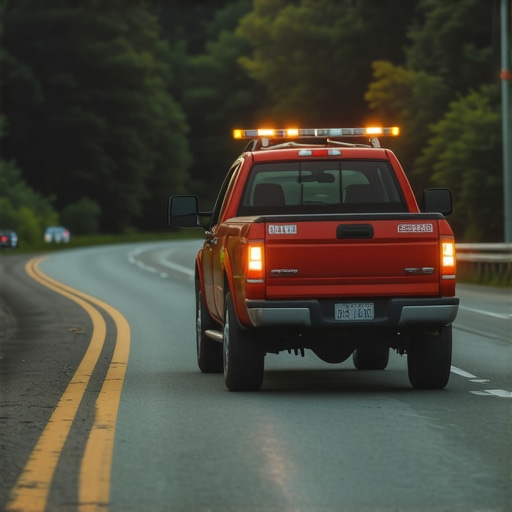
Why Your Elizabeth Towing Business Stays Invisible During Local Roadside Emergencies
Imagine this: It is 2 AM on a Tuesday. A cold rain is slicking the asphalt on the Goethals Bridge. A driver heading toward the Elizabethport neighborhood feels their engine sputter and die. Panicked, they pull over to the narrow shoulder, the lights of the NJ Turnpike blurring in their rearview mirror. They pull out their phone and type “towing elizabeth” into Google. Your shop is less than two miles away, perhaps located right off Route 1&9. You have the trucks, you have the crew, and you are ready to work. Yet, as the driver scrolls through the results, your business is nowhere to be found. Instead, they call a competitor from Linden or Newark who managed to snag the top spot. This is the “visibility gap,” and for many operators in Union County, it is the difference between a thriving fleet and a struggling yard.
As a Sales Representative at Elizabeth Truck Center, I spend my days talking to business owners who operate in one of the highest-traffic corridors in the United States. Between the Port of New York and New Jersey, Newark Liberty International Airport, and the dense residential corridors of Elmora and Peterstown, the demand for a local tow truck is constant. However, the competitive landscape in New Jersey is brutal. Simply existing in Elizabeth is no longer enough to guarantee you appear when a driver is in distress. You need to understand why your digital presence is failing to bridge the gap between your physical location and the customer’s smartphone. If you have ever wondered why your map ranking shrinks the moment you leave your office, you are experiencing the algorithmic roadblocks that keep local businesses invisible.
The Proximity Trap: Why Being “Near” Isn’t Enough for Google
Most towing operators assume that because they are the physically closest tow truck company to an accident, they will naturally appear first in search results. This is a dangerous misconception known as the “Proximity Trap.” While distance is one of Google’s three primary pillars for local ranking – alongside Relevance and Prominence – it is often the most misunderstood. Google’s goal is not necessarily to show the closest business, but the “best” business that is reasonably close. If a competitor three miles further away has a higher “brand velocity” – meaning more frequent reviews, better engagement, and a more complete profile – Google will often bypass you to show them instead.
This is particularly true for a tow truck company trying to capture high-intent emergency traffic. Google’s algorithm uses a “centroid” logic, but it also applies filters that can hide your business if it deems your profile less authoritative than others in the area. For instance, if your business hasn’t updated its Google Business Profile (GBP) in months, the algorithm may perceive you as less “ready” to respond than a shop that posts regular updates or photos of their fleet. This is a primary reason why proximity filters are hiding your best business locations. In a city like Elizabeth, where dozens of companies are vying for the same square mile of digital real estate, your prominence must outweigh your competitors’ proximity.
Furthermore, Google’s “near me” logic is heavily influenced by the user’s precise GPS coordinates. If a driver is stuck near the Mills at Jersey Gardens, and your shop is located near Warinanco Park, the algorithm considers the transit time and traffic patterns. However, if your digital footprint doesn’t explicitly link your services to those specific neighborhoods, you lose that relevance. To win, you must prove to Google that you are not just a business with an address, but a pillar of the Elizabeth community that is consistently active and trusted by local drivers.
The Elizabeth Context: Safety, Regulation, and Local Trust
Operating a towing business in Elizabeth, New Jersey, carries a unique set of responsibilities and challenges. Our city is a hub of logistics, but it has also seen the tragic consequences of roadside hazards. Recently, the community was shaken by a fatal accident involving a 16-year-old on a Lime e-scooter and a tow truck on the shoulder of an Elizabeth street. According to reports from NJ.com and the NY Post, this incident led to a city-wide ban on e-scooters and a heightened focus on how towing operators navigate our dense, often dangerous urban corridors. In this environment, “professionalism” is not just a buzzword; it is a vital ranking signal.
When residents or visitors search for 24 hrs towing, they are looking for more than just a hook; they are looking for safety and legitimacy. Google’s algorithm has become increasingly sophisticated at detecting “trust signals.” Following high-profile local incidents, the search engine often prioritizes businesses that have verified credentials, high-quality safety ratings, and a history of positive community interaction. If your business is seen as a “ghost” operation – lacking a physical storefront photo, clear licensing information, or recent reviews – the algorithm may suppress your ranking to protect the user.
In Elizabeth, where competition from companies like Quality 1st Towing and Tumi Towing is fierce, you must differentiate yourself through transparency. The local market demands that you demonstrate you are a vetted, professional operator. This means highlighting your safety protocols and your adherence to local NJ regulations within your business description. When you position your company as the safest choice for a local tow truck, you aren’t just appealing to the customer; you are feeding the algorithm the trust signals it craves to rank you higher in the 3-pack.
Technical Roadblocks: The “Invisible” Killers of Your Map Pin
Even the most reputable Elizabeth towing company can be rendered invisible by technical errors in their Google Business Profile. One of the most common issues I see at Elizabeth Truck Center is the “Verification Void.” If your GMB postcard was sent to a yard where no one checks the mail, or if you never completed the video verification process required for Service Area Businesses (SABs), your pin is essentially a ghost. Without full verification, you will never appear for high-value searches like motorcycle towing, regardless of how many trucks you have on the road.
Category mismatch is another silent killer. Many operators mistakenly list their primary category as “Auto Repair Shop” because they have a small garage on-site. While this might seem logical, it tells Google that your primary function is fixing cars, not moving them. If someone is searching for an affordable tow truck, Google will prioritize businesses whose primary category is “Towing Service.” You can add secondary categories, but your primary one must align with the emergency search intent of a stranded driver.
Perhaps the most frustrating technical hurdle is “Citation Spam.” If you recently bought your towing business or moved locations, there is a high probability that old, incorrect data still exists on the web. Inaccurate phone numbers or addresses on sites like Yelp, Yellow Pages, or local NJ directories create “NAP” (Name, Address, Phone) inconsistency. Google sees these discrepancies and loses confidence in your location data. This is a classic case of how old citation spam from previous owners still hurts your map rank. To fix this, you must perform a deep audit of every digital mention of your business to ensure Elizabeth’s drivers are getting the right information every time.
Service-Specific Visibility: Moving Beyond the Standard Hook
Generic searches are only half the battle. In a diverse economy like Elizabeth’s, customers often have very specific needs. A driver whose luxury SUV has stalled on Broad Street needs flatbed towing to ensure their vehicle isn’t damaged. A construction worker whose truck has slid into a ditch near the Elizabeth River needs an off-road towing service. If your Google profile only mentions “towing,” you are missing out on these high-intent, high-margin calls.
To be visible, your profile must reflect the full scope of your fleet. Google’s “Justifications” feature – those small snippets of text that appear under a search result saying “Provides flatbed towing” – are pulled directly from your website and your GBP “Services” menu. If you haven’t explicitly listed these services, you won’t trigger these justifications. This is why it is crucial to detail every capability you have. Whether it is heavy-duty recovery for rigs coming off the Turnpike or specialized equipment for tight-access parking garages in downtown Elizabeth, specificity breeds visibility.
Furthermore, consider the language of the customer. They aren’t just looking for “towing”; they are looking for a solution to a problem. They might search for “low clearance tow truck” or “winch out service.” By expanding your service list to include these keywords, you tell Google that you are the most relevant answer for a wide variety of “near me” queries. Don’t let a competitor win a lucrative recovery job simply because they were more descriptive on their profile than you were.
The “Near Me” Algorithm: Capturing the Emergency Search
The “near me” search is the lifeblood of the towing industry. When a driver types “tow trucks near” Elizabeth into their phone, they are usually in a state of high stress. They aren’t going to scroll to page two of the search results. They are going to look at the first three options in the Map Pack, check the star rating, and hit the “Call” button. To capture this traffic, your business must be optimized for mobile speed and local relevance.
Google’s algorithm for “near me” searches places a heavy emphasis on mobile site performance. If a driver clicks through to your website to find a flat tire tow truck and your page takes ten seconds to load, they will bounce back to the search results and call the next guy. In the world of emergency roadside assistance, speed is a ranking factor. Your website needs to be lean, fast, and feature a prominent “Click-to-Call” button that works flawlessly on every mobile device.
Moreover, you need to understand the specific signals that force your map pin to rank higher during these peak search times. This includes having a high volume of “fresh” reviews. A review from two years ago carries very little weight in a “near me” search. Google wants to see that you helped someone in Elizabeth *this week*. Encouraging your drivers to ask for a quick review after a successful jumpstart or tire change can dramatically increase your visibility during the next emergency search.
Action Plan: How to Reclaim Your Visibility in Elizabeth
Stopping the “invisibility” of your business requires a proactive approach. You cannot simply set up a profile and hope for the best. Start by performing a comprehensive audit of your Google Business Profile. Ensure your service area is correctly defined – it should cover all of Elizabeth and the surrounding municipalities like Roselle, Hillside, and Linden. Next, take high-quality photos of your trucks parked in recognizable Elizabeth locations. This provides Google with geographical context that text alone cannot provide.
Transparency is your greatest asset in winning the customer’s trust. When a driver is stranded, they are often worried about being overcharged. Providing a clear tow truck quote or a price range for standard services in your business description can set you apart from the “call for pricing” crowd. This transparency not only helps with conversion but also reduces the number of “price-shopper” calls that don’t result in jobs.
Finally, look to industry leaders for inspiration. For example, activatetowing.com provides a gold standard for how a service-area business should structure its digital presence. They offer clear, dedicated pages for everything from activatetowing.com jumpstarts to activatetowing.com lockouts. By creating a digital footprint that mirrors the physical reality of your service, you make it impossible for Google – and the drivers of Elizabeth – to ignore you.
Conclusion: Visibility is a Choice
In the competitive Elizabeth towing market, staying invisible is a choice. Every day that your map pin remains buried is a day that your competitors are taking your calls and building their authority at your expense. By understanding the interplay of proximity, technical health, and local trust, you can reclaim your spot at the top of the search results. Don’t let your fleet sit idle while drivers on the NJ Turnpike struggle to find you.
Audit your presence, optimize your profile, and commit to being the most visible, professional operator in Union County. If you need help navigating the complexities of business growth in the Elizabeth automotive sector, contact us at Elizabeth Truck Center. For those looking for advanced technical support to dominate the local map pack, visit helpmerankgmbs.com and start turning those “near me” searches into “on my way” calls today.