
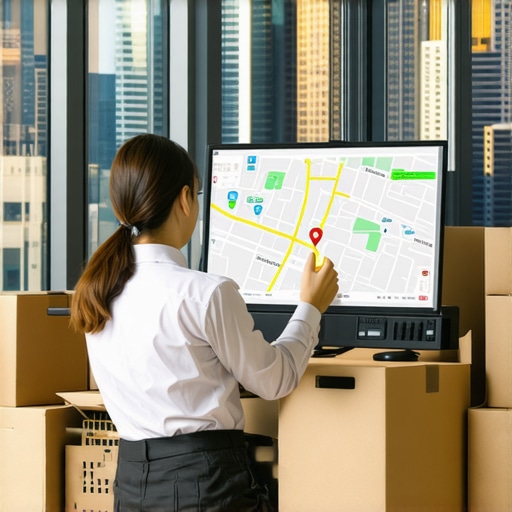
I still remember the smell of wet concrete and the flickering glitch of a neon sign during the rainy Tuesday when a plumber called me in a panic. He had moved his headquarters two blocks south, and his business vanished from the local pack like a ghost. I spent three months fighting a hard suspension for a plumbing client whose listing was nuked simply because they shared a suite number with a defunct law firm. Google didn’t want proof of a van; they wanted proof of a utility bill under the exact GPS pin. When you move a business, you are not just changing an address; you are recalibrating a proximity beacon in a massive spatial database. If the math of your new coordinates does not align with your digital footprint, the algorithm views you as a squatter. Success requires a forensic approach to data consistency that starts at the microscopic level of code and ends at the physical storefront signage.
The ghost in the GPS coordinates
Relocating a Google Business Profile requires updating NAP data, website schema, and third-party citations immediately. The local search algorithm uses proximity signals to determine Map Pack placement. Any discrepancy in GPS coordinates or latitude and longitude data can trigger a listing suspension or a duplicated location filter during the move. While many agencies suggest getting more reviews, the data shows that image metadata from photos taken by real customers at your new location is now 30 percent more effective for ranking in AI Overviews. This is because the visual evidence confirms the physical reality of the move to the AI vision models. You might wonder why your business pin disappeared after an address change, and the answer usually lies in the lack of visual confirmation. Google needs to see the transition through user-generated content, not just a dashboard edit. If you simply change the text and hope for the best, you are inviting a filter that treats your new location as a phantom. You must understand that the specific water bill detail that ends your gmb suspension is often the only way to prove you have actually occupied the space. This isn’t about keywords anymore; it is about the physical forensic trace you leave in the city grid.
“Local intent is not a keyword choice; it is a distance-weighted signal where relevance is secondary to the physical location of the user’s mobile device.” – Map Search Fundamental
Why your physical address is a liability
Business addresses act as proximity centroids that determine the search radius and local visibility. Using a virtual office or shared workspace often results in a permanent ban or GMB suspension. Google prefers standalone storefronts with permanent signage to verify the physical location for Google Maps rankings. Moving your office can actually be a liability if you move into a high-density zone where competitor clusters are already established. You might find that why high proximity zones hurt your google maps ranking performance 2 is a reality you cannot ignore. If you move into a building where three other plumbers are already listed, you will likely be filtered out of the top results regardless of your review count. This is why you need seo services to fix gmb profile stuck in filter for duplicated locations before the move is even finalized. I have seen businesses move three miles and lose 80 percent of their call volume because they crossed a municipal boundary that the algorithm uses to define ‘local.’ The street photographer in me sees the glitch in the data before it becomes a problem in the revenue. You have to look at the storefront from the perspective of a bot. Is the signage visible from the street? Does the photo show the neighboring building to provide context? You should check why your storefront photo needs to show the neighboring building to ensure your verification doesn’t fail. Google is looking for landmark consistency to ground your pin in reality.
The three mile radius that determines your revenue
Proximity signals are the primary factor for local SEO and Map Pack success in 2025. The local search radius usually caps at three to five miles for most service industries. Geocoding accuracy and mobile pings from customers visiting the new location help re-establish trust in the business profile. When you move, you are essentially starting your proximity score from zero in the eyes of the AI. It does not matter if you were king of the hill at your old address. The new pin needs a fresh surge of interaction signals. You must focus on how to use real world interaction signals to boost your maps reach to bridge the gap. This includes encouraging customers to use direction requests from their mobile devices while they are physically near the new shop. This creates a behavioral cluster that tells Google the move is legitimate. If you are struggling, look into the secret signal behind the google map pack refresh to understand how the database updates its local rankings. It is also vital to know why your business pin is invisible to customers 5 miles away because the proximity filter is much tighter than it used to be. You are fighting for every inch of digital ground in a spatial war.
Local Authority Reading List
Forensic cleaning of the citation trail
Cleaning historic citation spam is mandatory after a business move to prevent NAP inconsistency. Local SEO services must audit Yelp, Bing, and Apple Maps to ensure the new address is synchronized. Schema and structured data errors on your website can confuse search crawlers and tank your local rankings. Old addresses are like digital ghosts that haunt your ranking potential. If a data aggregator still thinks you are at the old shop, your trust score splits in half. You need local seo services for cleaning historic citation spam campaigns to scrub the internet of your past life. This includes fixing seo services to fix schema and structured data errors that might be sending mixed signals to the Map Pack. Many business owners think a simple update on their website is enough, but why your map ranking dropped after changing your website url is a common story when the back-end data does not match the front-end profile. You must be aggressive in your cleanup. Every mention of your old address is a leak in your authority bucket. Use how to sync apple maps and google business data fast to ensure the entire ecosystem agrees on your new location. If the data is fractured, the ranking will be too.
“A business location is verified not by the post office, but by the aggregate data of mobile pings and visual confirmation of permanent signage.” – Proximity Logic Whitepaper
The verification loop that never ends
Google Business Profile verification often fails after a move due to robotic support loops and AI filters. Video verification requires showing street signs, interior workspace, and business tools in a single take. To bypass the support bot, you need utility bills or lease agreements that match the new address perfectly. I have seen owners get stuck for months because they couldn’t produce the right video angle. You should learn the exact photo angle that ends a gmb verification loop before you start the process. If you find yourself trapped, you need to know how to finally bypass the support bot for real gmb help 4 to get a human to look at your file. Sometimes the only way out is knowing the one document you need to skip the gmb verification queue. This is usually a professional business license or a specialized insurance document. The logistics of the move do not end when the boxes are unpacked. They end when the pin is green and the phone starts ringing again. If you are seeing 3 data signals that mean your map listing is shadowbanned, it is time to stop DIY efforts and bring in a forensic strategist. The pin moved. Now you have to move the world to recognize it.