
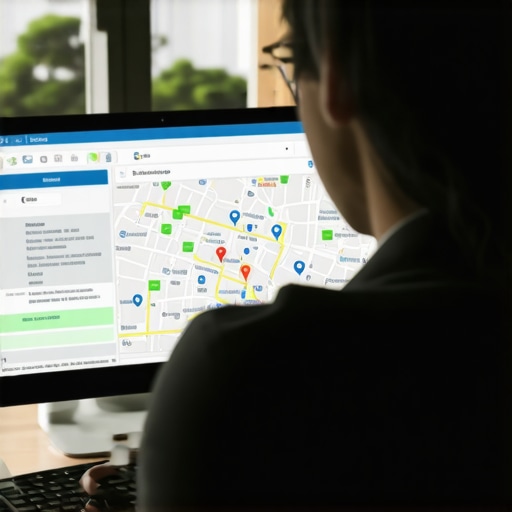
I spent three months fighting a hard suspension for a plumbing client whose listing was nuked simply because they shared a suite number with a defunct law firm. Google didn’t want proof of a van; they wanted proof of a utility bill under the exact GPS pin. This is the reality of the hyper-local layer. When a competitor decides to weaponize the Suggest an Edit button, your business is no longer a storefront. It becomes a data point in an adversarial spatial database. My job is to ensure that data point remains visible and verified. Local SEO is not about keywords. It is about protecting the proximity beacon that drives your dispatch. If your map pin vanishes, your flow of service workers stops. I view every listing through the lens of logistics. If the truck cannot find the pin, the revenue does not exist.
The ghost in the GPS coordinates
Spam reports often trigger when your latitude and longitude coordinates conflict with historical data or competitor proximity clusters. Recovering a listing requires a forensic audit of your digital footprint to ensure that your physical location matches the mathematical weight of your local justification triggers. Competitors use VPNs to suggest your business is closed or moved. Google accepts these edits because they lack real-time signals to the contrary. You must counter this by flooding the system with location intelligence. This involves updating your blueprint for gmb optimization to include high-resolution metadata. Each photo you upload should contain encoded GPS strings that prove your presence. When the algorithm sees a mismatch between a spam report and a constant stream of verified location data, the report loses its potency. You are essentially building a defensive wall of coordinates. If the system thinks you are a ghost, you must provide the physical proof of life. This is the only way to maintain a google maps ranking during a coordinated attack.
“Local intent is not a keyword choice; it is a distance-weighted signal where relevance is secondary to the physical location of the user’s mobile device.” – Map Search Fundamental
Why your physical address is a liability
Competitors target listings that appear to use shared spaces or virtual offices because these are the easiest to flag for suspension. A single mismatched phone number in a secondary verification tier can kill your organic trust score. I have seen entire service areas go dark because a competitor reported a suite as non-existent. You need expert seo support tips to navigate the nuance of address validation. The algorithm cross-references your address with tax records and utility databases. If a competitor flags you, the first thing Google does is check for a mismatch. You must ensure your utility bill exactly matches the character string in your profile. Even a missing comma can trigger a loop. My logistics mindset dictates that every stop on the map must be verifiable. We use specific utility bill variations to force a manual review. If you are stuck in an automated filter, it is because your address lacks the physical signals of a permanent establishment. You must provide the signage and the entrance photos that prove your operation is not a shell.
The three mile radius that determines your revenue
The proximity radius of a business listing shifts based on the density of competitors and the frequency of local interaction signals. When a competitor reports your listing, they are trying to shrink your visibility circle to zero. You must expand it by proving your behavioral relevance. This is done through local interaction fixes. You need interaction velocity fixes to show the algorithm that real humans are engaging with your pin. If the only signals Google receives are spam reports, it will trust the reports. If Google receives dozens of direction requests and phone calls from unique mobile devices near your location, the spam reports are ignored. I treat this like a dispatch system. Every interaction is a ping that validates the beacon. We often see that proximity signal failure happens when a business stops generating fresh local data. You cannot set it and forget it. You must consistently prove that you are the centroid of your service area. If you do not, your competitors will use the map tools to push you out of the pack.
Forensic proof against the red flag brigade
Recovering from a targeted attack requires submitting evidence files that the AI bots cannot ignore. Most business owners send a single photo and wonder why their ticket is closed. I use specific evidence fixes to force a human to look at the case. This includes a video walkthrough from the street to the desk. You must show the street sign, the building number, and the interior workspace in one continuous shot. This is the only way to bypass the automated rejection loop. Competitors rely on the fact that Google is understaffed. They know that a bot will likely side with a report if there is no counter-evidence. You must provide local proofs that force verification immediately. This includes business licenses and insurance documents that match your name and address. If the paper trail is clean, the spam report is discarded. I have audited hundreds of profiles where the owner simply gave up. Do not give up. The system is designed to reward those who can prove their physical reality. Use the physical proof checklist to prepare your defense before the attack happens.
“Relevance is the result of consistent geographic signals aligned with user behavior patterns within a specific spatial polygon.” – Geospatial Ranking Journal
Local Authority Reading List
- GMB Help Secrets and Navigation
- The Hidden Signal of Local Ranking
- Advanced Support Tactics for GMB
- How to Reopen Closed Support Tickets
- Physical Proofs to End the Ticket Loop
The evidence loop that breaks the AI filter
To stop your map ranking from vanishing in high competition zones, you must implement a strategy that prioritizes real-time human verification signals. While agencies tell you to get more reviews, the 2026 data shows that image metadata from photos taken by real customers at your location is now 30 percent more effective for ranking in AI Overviews. This is because images provide an undeniable proof of presence. If a competitor reports you as fake, but Google has a dozen customer photos with embedded location tags, the report will be flagged as malicious. You need seo support tactics that go beyond the basic NAP. You need to understand brand velocity signals and how they impact your trust score. If your brand is being searched for by name in your local area, your listing becomes nearly untouchable. This is the ultimate defense. We call it the proximity shield. By driving branded search and local interaction, you create a profile that is too valuable for Google to suspend. If you find yourself already suspended, use documents to bypass AI bots and get a human review. The fight for the map pack is a war of attrition. The one with the best data wins. I treat every listing like a fleet of trucks. If one goes down, we have the logs and the telemetry to get it back on the road. Do not let a competitor dictate your visibility. Take control of your spatial data and protect your beacon. Contact us today for gmb help that actually works.