
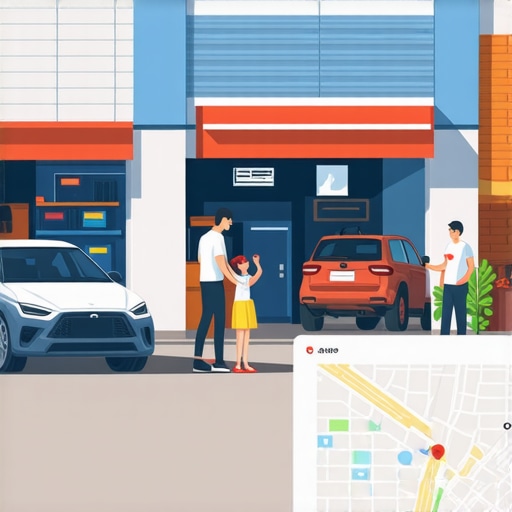
The proximity glitch that keeps your auto repair center off the map during local AC emergencies
It is a sweltering Tuesday afternoon, and the thermometer on the dashboard reads a punishing 102 degrees. For a driver stuck in stop-and-go traffic, the sudden blast of humid, hot air from the vents isn’t just an inconvenience – it is a full-blown emergency. In a state of mild heatstroke and rising frustration, the driver reaches for their smartphone or uses a voice command to execute a high-intent search: auto ac repair near me. This is the “Panic Search,” a high-stakes moment where a customer is ready to spend money immediately to solve a physical crisis.
However, a strange phenomenon often occurs in these moments, one that leaves high-quality shop owners scratching their heads. Despite having hundreds of five-star reviews and decades of experience, a premier auto repair center might be completely invisible in the search results, while a mediocre shop with three reviews appearing just half a mile closer to the driver takes the lead. This is known among SEO specialists as the “Proximity Glitch.” It is a fundamental bias in Google’s local algorithm that prioritizes the physical distance of a car repair shops over their actual service quality or relevance, effectively “glitching” the map and hiding the best options from the people who need them most.
According to research from CI Web Group, voice search and “near me” queries are increasingly driven by panic-driven, high-intent scenarios. When the AC fails, the user isn’t looking for a blog post on how compressors work; they are looking for a bay that is open right now. If your auto repair shop is caught on the wrong side of the proximity radius, you are losing the most profitable leads of the summer season.
Anatomy of the Proximity Glitch: Why Google Limits Your Reach
To understand why your auto service and repair business might be struggling to appear for customers just a few blocks away, we have to look at how Google Maps functions. Google’s primary goal is to provide the most “convenient” answer to a user’s query. For emergency services, Google’s algorithm places an overwhelming weight on the user’s current GPS coordinates. While “Relevance” and “Prominence” are supposed to be equal pillars of local SEO, “Proximity” often acts as a gatekeeper that filters out superior shops.
This creates what we call the “proximity trap.” Even if you are the highest-rated auto repair shop in the city, Google may perceive a two-mile distance as “too far” for a user searching for an emergency fix. This is particularly frustrating for shops located in industrial zones or on the outskirts of major commuting hubs. The algorithm’s Natural Language Processing (NLP) interprets the urgency of the search and defaults to the tightest possible radius, assuming the driver wants the absolute closest physical location, regardless of that shop’s ability to actually perform a complex car electrical system repair.
This glitch is exacerbated by the “Possum” update, which was designed to diversify local results but often ended up filtering out businesses that share a similar category and are located near one another. If your shop is in a “repair row” with five other competitors, the proximity glitch might pick one and hide the rest, simply to provide “variety” to the user, even if you are the only one with the specialized equipment to handle modern R-1234yf refrigerant systems.
Why AC Emergencies are Different: The Psychology of the Map Pack
In the world of auto service and repair, not all searches are created equal. A “scheduled oil change” search is a research-based task. The customer might look at five different car repair shops, compare prices, and read dozens of reviews. They are willing to drive 10 or 15 miles for a shop they trust. However, an AC failure in the middle of July is a different beast entirely. It is a behavioral shift from “research” to “rescue.”
In a crisis, speed beats research every single time. If your shop isn’t in the “Map Pack” – the top three local listings displayed on the Google Search Results Page – you effectively do not exist to that driver. Research shows that over 70% of clicks in local mobile searches go to the Map Pack. For an AC emergency, that number likely climbs higher because the user is often operating their phone in a hot car, looking for the quickest “Call” or “Directions” button. You can learn more about why your auto repair center stays invisible for local AC repair searches to better understand these behavioral patterns.
The proximity glitch essentially punishes the user by giving them the closest option rather than the best one. For a shop owner, this means that even if you have optimized your website perfectly, your Google Business Profile (GBP) must be hyper-optimized to break through that proximity barrier and signal to Google that your “Prominence” should override the user’s “Proximity.”
The Technical Connection: Why AC Repair is Actually a Car Electrical System Repair
One of the reasons many shops fail to rank for AC-related terms is a misunderstanding of how Google categorizes services. Modern automotive HVAC systems are no longer simple mechanical loops. They are deeply integrated into the vehicle’s computer network. Often, an AC failure isn’t a leak or a lack of Freon; it is a communication error between the climate control module and the engine control unit.
To capture the widest possible net of “near me” searches, a shop needs to be recognized as an authority in car electrical system repair. Technical data suggests that common failure points like compressor control valves, blown clutch relays, and melted electrical connectors are the true culprits behind “hot air” complaints. Many DIY-inclined drivers attempt the “paper clip bypass” on a relay – a risky move that can fry a vehicle’s expensive computer system. When they realize they are in over their heads, they search for professional help.
If your auto repair center only optimizes for “AC recharge,” you are missing out on the high-ticket diagnostic leads. Google’s algorithm looks for “semantic triplets” – related terms that prove you have a deep understanding of the subject. By mentioning specific technical failures like “Compressor Solenoids” or “Wiring Line Bypasses” in your GBP updates and website content, you signal to the algorithm that you are a comprehensive auto repair shop capable of handling more than just a simple “gas-and-go” service. This technical authority helps push your ranking radius further, as Google realizes your shop is a “destination” for specialized repairs, not just a commodity service.
Competitor Awareness: National Chains vs. Local Independent Shops
The proximity glitch often works in favor of national chains. These massive corporations have the budget to “carpet bomb” a geographic area with localized landing pages and thousands of citations. They use “location power” to ensure they show up in every 2-mile radius across a city. This can make an independent auto repair shop feel like it is fighting an uphill battle.
However, local shops have a secret weapon: “Brand Velocity” and “Local Signals.” While a national chain might have a generic description for 500 locations, a local auto repair shop can tailor its content to the specific needs of its community. For example, a shop in Albuquerque might focus on the specific dust and heat issues unique to the high desert, which helps them rank for queries like Why Your Albuquerque Auto Repair Shop Stays Hidden During Peak Downtown Commutes.
To fight the proximity glitch, you must differentiate your auto service and repair business by proving your local relevance. Google tracks “real-world signals,” such as how many people search for your shop by name after seeing your sign, or how many people click for directions and actually complete the trip. By building a strong local brand, you can train the algorithm to realize that users are willing to bypass the “closest” shop to get to *your* shop. This “user intent” is one of the few factors that can actually override the proximity bias.
Solving the Glitch: Actionable Steps for Shop Owners
If you suspect your auto repair center is being hidden by the proximity glitch, you need a proactive strategy to expand your ranking radius. You cannot move your building, but you can move your digital “pin” in the eyes of the algorithm. Here is a checklist to help you dominate the auto ac repair near me market:
- Optimize Google Business Profile Categories: Ensure your primary category is “Auto Repair Shop,” but use secondary categories like “Air Conditioning Repair Service” and “Car Electrician.” This helps the algorithm understand the breadth of your auto service and repair capabilities.
- Capture Natural Language Reviews: Encourage customers to leave detailed reviews. A review that says, “They provided the best auto ac repair near me in [Your City] when my compressor died,” is worth ten reviews that just say “Good job.” The NLP algorithm picks up these location and service keywords to broaden your reach.
- Address Service Area Settings: Many shops incorrectly set up their GBP as a “Service Area Business” (SAB) without a physical address shown, or they set their radius too wide. If you have a physical auto repair shop, ensure your address is verified and visible. This builds more trust with Google than a vague service area.
- Increase Brand Velocity: Use social media and local sponsorships to get people searching for your shop by name. When Google sees a spike in “Brand + AC Repair” searches, it realizes you are a preferred provider and will often expand your visibility radius to 5, 10, or even 15 miles. You can see an example of how we expanded a local ranking radius by 10 miles using these specific tactics.
- Technical Content Silos: Create pages on your website specifically for car electrical system repair and AC diagnostics. Link these pages to your GBP posts to create a “relevance loop” that the algorithm can’t ignore. For deeper insights, check out The Blueprint for GMB Optimization: Boost Google Maps Visibility or explore GMB Help Secrets: Navigating the Algorithm for Top Rankings.
Conclusion: Quality Should Outrank Proximity
The proximity glitch is a frustrating reality of the modern digital landscape, but it is not an insurmountable one. For the car owner, it is a reminder that the first result on the map isn’t always the best auto repair shop for the job. Sometimes, driving an extra two miles can mean the difference between a temporary “band-aid” fix and a professional repair that lasts the entire summer.
For the shop owner, understanding the mechanics of local SEO is the only way to ensure your auto repair center remains visible when the heat waves hit and the “Panic Searches” begin. Proximity is a factor, but through strategic optimization, technical authority, and brand building, your quality can – and should – outrank a competitor’s zip code.
About the Author
Jo Ann McLellan is an Internet Expert in SEO & Web Design for car repair shops, Dealerships, and Tire shops. With years of experience navigating the complexities of the Google Business Profile algorithm, she helps automotive businesses break through the proximity glitch to reach their ideal customers. Jo Ann offers specialized strategies to ensure your auto repair shop isn’t just on the map, but at the top of it. Looking to grow your visibility? Get a FREE website analysis at helpmerankgmbs.com.