
The Simple Map Profile Shift That Helps Your Restaurant Patio Design Business Outrank National Firms
For many local designers, the digital landscape feels like a David vs. Goliath battle. You have the “boots on the ground” expertise, but when a local restaurateur searches for a professional to overhaul their outdoor dining space, they are often met with a wall of national aggregator sites and massive franchises. It is a frustrating reality: local experts losing high-value leads to national firms with deep pockets. However, 2024 has brought a significant pivot in search behavior and algorithmic priorities. The “Map Profile Shift” is a strategic realignment of how Google Business Profiles (GBP) are categorized and optimized, favoring hyper-local relevance over broad national brand authority.
Google Business Profile remains the #1 growth tool for local businesses in 2024. By shifting your profile from a generalist landscape architect to a specialized local authority, you can bypass the organic dominance of national competitors. This shift isn’t about outspending the giants; it is about out-localizing them. In this guide, we will explore how to implement this shift to ensure your business is the first choice for every restaurant patio design project in your region.
Why National Firms Win (and How They Are Vulnerable)
National firms and lead-generation aggregators dominate the search engine results pages (SERPs) primarily through massive SEO budgets and high domain authority. They produce thousands of pages of content, targeting broad keywords like online landscape design. Because they have thousands of backlinks and a nationwide footprint, they often sit comfortably at the top of organic results. However, their greatest strength – their scale – is also their primary vulnerability when it comes to the local Map Pack.
Google’s local algorithm relies heavily on three pillars: Relevance, Distance, and Prominence. While national firms have prominence, they often fail miserably at “Proximity” and “Hyper-Local Relevance.” They lack the specific local signals that Google craves for Map Pack rankings. For example, a national aggregator cannot easily provide a local address with a consistent history of local check-ins, local reviews mentioning specific neighborhood landmarks, or a service menu tailored to the local climate and zoning laws. If you have been wondering Why your online landscape architecture firm is invisible in the local map pack, it often comes down to failing to exploit these local gaps that national firms cannot fill.
National firms offer a detached experience. They might provide a generic digital plan, but they cannot walk the site, understand the specific wind patterns of a coastal patio, or know the local municipal codes for permanent outdoor structures. By focusing your Map Profile on these granular local details, you create a “relevance shield” that national firms cannot penetrate. You aren’t just a designer; you are a local specialist who understands the unique challenges of the area’s hospitality industry.
The “Map Profile Shift” Explained: From Generalist to Specialist
The core of the Map Profile Shift lies in moving away from being a “Landscape Designer” in the eyes of Google and moving toward being a specialized solution provider. Most design firms set their primary category and then forget about the rest of the profile. To outrank national firms, you must treat your GBP as a dynamic sales funnel. The shift involves a strategic use of secondary categories and the often-neglected “Service” menu to target high-intent keywords like restaurant patio design.
First, evaluate your primary category. While “Landscape Designer” is the standard, adding secondary categories such as “Landscape Architect” or “Deck Builder” provides a broader net. However, the real magic happens in the Service Menu. Google uses the services you list to create “justifications” – those small snippets of text in the search results that say “Provides: 3D modeling” or “Sold here: Outdoor kitchens.” By explicitly adding 3D landscape design services to your menu, you are feeding the algorithm specific data points that national firms, who often use generic service descriptions, miss.
Furthermore, the “Shift” requires you to optimize your service descriptions with local intent. Instead of saying “We design patios,” say “We specialize in outdoor dining renovations for restaurants in [City Name], focusing on high-traffic durability and local building compliance.” This level of specificity triggers Google’s relevance filter. When a restaurant owner searches for a designer, Google’s AI scans for the most relevant match. A local profile with a dedicated service for commercial patios will almost always beat a national firm that only mentions “commercial services” in a long list of general offerings. To truly master this, you should look into Transform Your Business with Effective Google Maps SEO Strategies to refine how these services are displayed to potential clients.
Leveraging 2024 Design Trends to Boost Engagement Signals
Google doesn’t just look at what you say you do; it looks at how users interact with your profile. High engagement signals – such as photo views, dwell time, and “Request a Quote” clicks – tell Google your profile is valuable. In 2024, restaurant owners are looking for specific trends: “Biophilic Design” and “Botanical Oases.” These aren’t just buzzwords; they are search trends that you can capitalize on through your visual content.
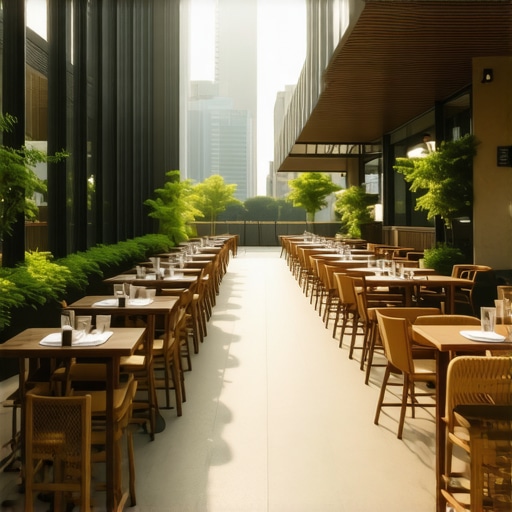
Biophilic design, which integrates natural elements into the built environment, is the top demand for 2024 restaurant patios. Restaurateurs want to create a “Green Ambiance” that provides privacy and a psychological escape for diners. By uploading high-resolution photos of projects featuring lush, vertical gardens or drought tolerant landscape design, you increase the “dwell time” on your profile. When a user spends three minutes scrolling through your portfolio of botanical oases, Google notes that your profile is highly relevant to the query.
Additionally, focus on “Safety-First” and functional commercial trends. Modular wicker seating and anti-tip tables are major concerns for restaurant managers who need to balance aesthetics with liability and flexibility. Mentioning these specific elements in your GBP “Updates” or photo captions shows that you understand the commercial sector’s unique needs. This specialized knowledge builds trust not just with the algorithm, but with the human being on the other side of the screen. If you’re looking for a deeper dive into the foundation of these profiles, The Blueprint for GMB Optimization: Boost Google Maps Visibility provides a comprehensive look at setting up these engagement-heavy profiles.
Technical Optimization: Categories, Attributes, and Proximity
The backend of your Google Business Profile is where the battle for the Map Pack is won or lost. One of the most common mistakes local designers make is “category hopping.” While it is tempting to change your primary category to match a seasonal trend, you must be careful. Why changing your GMB category often results in a traffic cliff is a common phenomenon where the algorithm loses its “understanding” of your business, causing a temporary but devastating drop in rankings. Instead of changing your primary category, use attributes and secondary categories to broaden your reach.
For restaurant-focused designers, the “Outdoor Seating” attribute is a hidden gem. While typically reserved for the restaurants themselves, Google often allows service providers to select attributes that reflect the projects they complete. Furthermore, ensure you are utilizing the “Service Area” settings correctly. If you specialize in backyard deck construction for boutique cafes, your service area should reflect the specific commercial hubs of your city, rather than a generic 50-mile radius.
Another technical nuance is the use of “Product” posts. You can list “Restaurant Patio Packages” as products on your GBP. This allows you to include a price range, a detailed description, and a direct link to your website. This bypasses the traditional search results and puts your specific commercial offerings directly in the face of the consumer. It is a powerful way to Stop over-optimizing your service descriptions and start ranking by letting your “Products” do the talking. By aligning your technical settings with the specific needs of the hospitality industry, you create a profile that is much more “clickable” than a national firm’s generic listing.
The Power of Visual Proof: 3D Mockups and Digital Design
In the world of online deck designer services, visuals are the ultimate currency. A restaurant owner isn’t just buying a patio; they are buying a vision of a packed house and increased revenue. This is where digital landscape design becomes your strongest closing tool. As Ryan Delia, a Landscape Architecture and Outdoor Living Expert, often notes: “My team designed and built custom gardens to suit tastes, needs, and budget – and the first step is always the 3D visualization.”
Uploading 3D mockups to your Google Business Profile serves two purposes. First, it demonstrates a high level of professional capability that national “referral” sites cannot match. Second, it provides “visual justifications” in search results. When someone searches for “modern restaurant patio ideas,” Google may show a photo from your profile directly in the search results. If that photo is a stunning, high-contrast 3D mockup of a botanical dining space, your click-through rate will skyrocket.
Digital designs also allow you to showcase your ability to handle complex commercial requirements. You can show how you integrate lighting, heating elements, and drainage – all critical components of a successful restaurant patio. By positioning yourself as a tech-forward 3D landscape design services provider, you differentiate yourself from the “old school” contractors who only provide hand-drawn sketches. This modern approach is exactly what 2024 business owners are looking for: precision, speed, and a clear vision of the final product before the first brick is laid.
Overcoming the Proximity Filter
One of the most frustrating aspects of Google Maps is the “Proximity Filter.” You might rank #1 when you are standing in your office, but drop to #10 when you are three miles away at a client’s restaurant. This happens because Google prioritizes the “centroid” of the search. To combat this and expand your ranking radius for projects like ranch landscape design or large-scale commercial patios, you need to build “Brand Velocity.”
Brand Velocity is the speed at which your brand is mentioned and searched for online. You can build this by generating a steady stream of local reviews from different parts of the city. Encourage your restaurant clients to leave reviews that mention their specific neighborhood. For example, “The best patio designer in the Pearl District!” tells Google that your relevance extends beyond your physical office location. If you’ve seen a sudden drop in your visibility, you may need to learn How to reverse a ranking drop caused by proximity filters through localized content clusters and geo-tagged image uploads.
Local citations also play a role. Ensure your business is listed in local business directories, the local Chamber of Commerce, and hospitality-specific associations. These local links act as “anchors” that keep your profile relevant across a wider geographic area. To stay ahead of the curve, keep an eye on Mastering Google Maps Ranking: Proven GMB Help Strategies for 2025, as proximity filters are expected to become even more sophisticated.
Conclusion & Call to Action
Outranking national firms in the restaurant patio design space isn’t a matter of having a million-dollar marketing budget. It is about understanding the “Map Profile Shift” and leaning into your greatest advantage: your local identity. By optimizing your categories, leveraging 2024 design trends like biophilic botanical oases, and showcasing high-end 3D visualizations, you create a Google Business Profile that is an irresistible magnet for local restaurateurs.
National firms can offer a plan, but they cannot offer the local expertise, the proximity, and the tailored service that a dedicated local firm provides. It is time to stop letting aggregators take your leads. Audit your Google Business Profile today, implement these strategic shifts, and claim your spot at the top of the Map Pack. If you need assistance in crafting a digital presence that converts, contact an online landscape design company that understands the intersection of high-end design and local SEO strategy.