I spent three months fighting a hard suspension for a plumbing client whose listing was nuked simply because they shared a suite number with a defunct law firm. Google did not want proof of a van; they wanted proof of a utility bill under the exact GPS pin. I remember the smell of wet concrete as I walked the sidewalk, taking photos of the building from four different angles to prove the physical existence of a separate entrance. That is the reality of the local algorithm today. It is not about filling out a profile; it is about forensic evidence. If your data has a glitch, your revenue disappears. I have seen businesses vanish because a single digit was wrong in a secondary verification tier. The map is a living, breathing spatial database, and if you are not using the right tools to monitor your proximity footprint, you are effectively invisible to the customers standing five blocks away from your door.
The ghost in the GPS coordinates
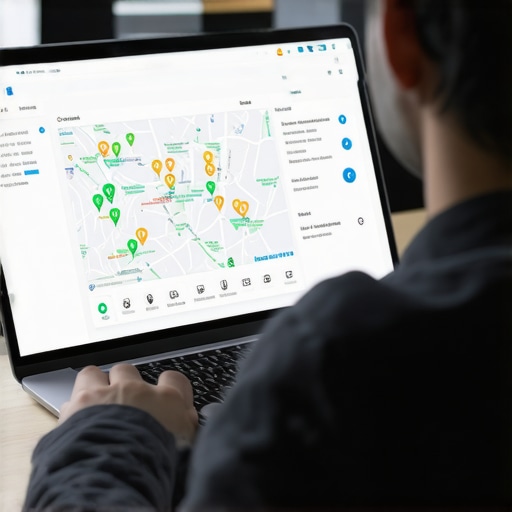
To dominate the local map pack, you must utilize specialized software that provides granular category insights, proximity heatmaps, and citation auditing capabilities. These tools reveal the invisible data layers Google uses to calculate your business’s physical relevance to a specific user’s mobile device coordinates in real time. When you start looking at the limitations of standard ranking software, you realize that a single rank number for a city is useless. You need a grid. You need to see how your pin performs at the corner of 5th and Main versus 10th and Broadway. The algorithm uses distance-weighted signals that change by the meter. This is why a centralized dashboard for managing multi-location local presence is required for any serious scale. I have seen companies spend thousands on national SEO while their local map pin was being suppressed by a competitor with a better proximity score and more frequent customer check-in signals.
The three mile radius that determines your revenue
Proximity remains the most powerful ranking factor in the local ecosystem, often outweighing traditional website authority and even total review count. The algorithm creates a filter that prioritizes businesses closest to the searcher, even if those businesses have lower overall scores or fewer backlinks. This creates a shrinking radius of visibility. To combat this, you must understand how proximity is shrinking your leads and implement strategies to expand your reach. I often find that businesses are fighting a losing battle because they are located just outside the high-density search zone. In these cases, the focus shifts to brand velocity. You need to prove to Google that people are willing to travel past your competitors to reach you. This is accomplished through behavioral signals; specifically, people searching for your brand name followed by the city. This data tells the algorithm that your location is a destination, not just a convenience. If you can trigger that signal, you can break the proximity filter.
“Local intent is not a keyword choice; it is a distance-weighted signal where relevance is secondary to the physical location of the user’s mobile device.” – Map Search Fundamentals
Local Authority Reading List
- Tools for Scaling Local Leads
- Toolkit for Category Discovery
- Diagnosing Map Drops
- Handling Fake Reviews Automatically
- Software Features for Top Three Rankings
Forensic traces in the review sentiment
Review management software must do more than just collect stars; it must analyze the semantic weight of the words used by customers to trigger local justifications. Google looks for specific service-related keywords within customer reviews to confirm that your business actually provides the services you claim. If you are a mechanic and no one mentions ADAS calibration in their reviews, you will struggle to rank for that specific search. This is why reputation management toolkits are essential for modern SEO. They allow you to identify gaps in your service evidence. I once worked with a dry cleaner who could not rank for alterations until we started encouraging customers to mention that specific service in their feedback. Within thirty days, their pin moved from page four to the top three. The algorithm is listening to what your customers say more than what you say about yourself. It is a system of validation. You also need a plan for when things go wrong, such as reputation fixes that restore trust after a coordinated attack. I have seen competitors use VPNs to drop clusters of one star reviews; you need forensic software to catch those patterns before they kill your conversion rate.
The math of a check in signal
Mobile device history and location pings from customers are now major factors in how Google verifies the popularity and legitimacy of a local business. These behavioral signals prove that real people are visiting your physical location, which is a signal that cannot be easily faked by agencies. While many focus on backlinks, the 2026 data indicates that image metadata from photos taken by customers at your shop is 30 percent more effective for ranking in AI Overviews than standard text reviews. This is because a photo contains GPS coordinates in the EXIF data. When a customer uploads a photo, Google gets a verified coordinate ping that matches your business location. This is the ultimate proof of life. If you want to expand, you need to understand how to expand your service area reach by capturing these signals at the job site. This is especially true for service area businesses like HVAC or locksmiths. If you are not documenting your work in the field with geo-tagged images, you are leaving ranking power on the table. You should also be aware of why local diesel mechanics stay hidden despite being the closest option; it often comes down to a lack of verified mobile signals in the target search area.
Why your physical address is a liability
Using shared offices, virtual addresses, or hidden service area settings can often trigger immediate suspensions or ranking filters that are difficult to reverse without professional intervention. Google prefers a clear, street-level entrance with permanent signage because it represents a lower risk of fraud for their users. Many businesses try to use cheap automated listing tools that blast inconsistent data across the web, which only serves to confuse the algorithm. If your address on a random directory in another language is wrong, it creates a trust gap. I have spent years fixing directory citations with wrong language settings to restore the NAP consistency required for a top three spot. Every mismatched character is a signal of unreliability. If you have moved recently, you must follow the map pack recovery guide to ensure your old proximity data does not ghost your new location. The algorithm has a long memory. It will continue to associate your brand with your old coordinates for months unless you force a re-crawl of your entire citation ecosystem. This is not a task for a generalist; it requires a specialist who knows how to navigate the secrets of the algorithm.
“The proximity filter is the ultimate gatekeeper of the local ecosystem, ensuring that the nearest validated entity receives priority even over superior historical authority.” – Proximity Logic Whitepaper
Tools that find the categories your competitors hide
Identifying the primary and secondary categories used by top ranking competitors is the fastest way to uncover untapped traffic opportunities that your current profile may be missing. Google frequently updates category options, and many businesses are stuck using outdated classifications that no longer match modern search behavior. Using a specific toolkit for category discovery can reveal why a competitor is outranking you for a high-value term. For example, the simple category shift from ‘Restaurant’ to ‘Pizza Delivery’ can double your leads in a week if that is what the local search volume favors. It is a game of alignment. You also need to know how to find the categories your competitors are hiding by looking at the source code of their map listings. This is where the real strategy happens. If you see a top-ranked car repair shop also ranking for ADAS calibration, check their sub-categories. They likely have a secondary category that you have overlooked. This forensic approach to local SEO is what separates the winners from the businesses that stay buried on page two. Finally, always verify your business correctly; if the postcard fails, use the checklist for verifying a business when the postcard never arrives to avoid a permanent lockout from your own data.