
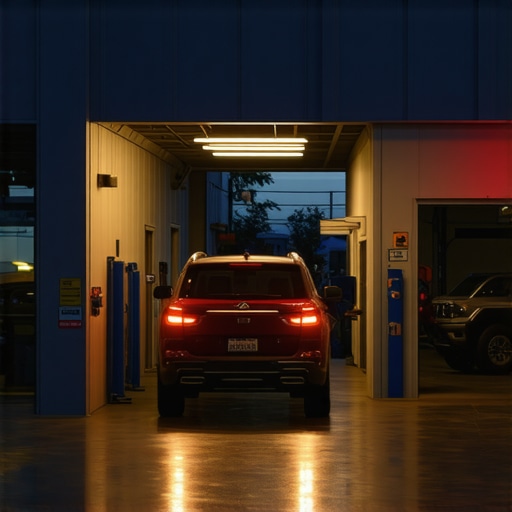
Why Your Auto Repair Shop Disappears When Local Drivers Search for ADAS Calibration
As an ADAS calibration technician who has spent years under the hood and in front of targets at Mobile Auto Solutions, I’ve seen the industry transform. We aren’t just turning wrenches anymore; we are managing sophisticated rolling computers. However, there is a recurring frustration I hear from shop owners across the country. They invest tens of thousands of dollars in specialized equipment, level their floors, and train their staff, yet when a local driver searches for a specialized auto repair shop capable of handling safety system resets, their business is nowhere to be found. They are essentially invisible for ADAS calibration searches.
This “disappearing act” isn’t just a marketing headache; it’s a business-critical failure. Advanced Driver Assistance Systems (ADAS) represent the fastest-growing segment of automotive repair. If your shop is a trusted local fixture but fails to appear when customers search for these high-tech services, you are losing the highest-margin work available today. In this guide, we’ll explore why your digital presence is failing to keep pace with your technical capabilities and how to ensure your shop becomes the local authority for vehicle safety technology.
The High-Stakes Reality of ADAS Calibration
To understand why being found for these searches is so vital, we have to look at the safety implications. ADAS technology – including automatic emergency braking, lane-keep assist, and adaptive cruise control – is estimated to prevent 3.59 million crashes per year. These systems are no longer luxury features; they are standard equipment on almost every vehicle rolling off the assembly line. But these systems are only as good as their last calibration.
Calibration is the process of ensuring that a vehicle’s sensor readings perfectly match the physical geometry of the car. When a camera is mounted behind a windshield or a radar sensor is tucked behind a bumper, even a microscopic misalignment can have catastrophic results. For example, if a front-facing camera is off by just a fraction of a degree, it might misinterpret a lane marking or fail to “see” a pedestrian in time to engage the brakes. As technicians, we know that The Technical Fixes That Stop Your Business From Vanishing in the Map Pack often start with demonstrating this level of precision to both customers and search engines alike.
When a vehicle undergoes a common repair – such as a windshield replacement or a suspension adjustment – those sensors are disturbed. If the shop performing the mechanical work doesn’t show up in a local search for calibration, the vehicle often leaves the bay in an unsafe state, or the revenue is outsourced to a dealership. Your invisibility in search results isn’t just costing you money; it’s potentially putting uncalibrated vehicles back on the road.
The “Alignment Near Me” Connection: Why One Requires the Other
One of the biggest missed opportunities in the automotive world is the disconnect between mechanical service and software calibration. Most modern vehicles require an ADAS reset immediately following a wheel alignment. If you are ranking for an alignment near me, but failing to show up for the subsequent calibration search, you are only capturing half the job. In many cases, the customer will find a shop that can do both, leaving your bay empty.
The technical reality is that ADAS calibration starts long before the targets go up on their stands. It starts with the chassis. You cannot calibrate a lane-departure system on a car with a crooked thrust angle. Because the sensors “look” where the car is pointed, the mechanical alignment is the foundation of the entire safety system. When a customer searches for an alignment near me, they are often unknowingly searching for the first step of a multi-stage safety recalibration.
By failing to link these two services in your digital presence, you lose authority. Google’s algorithms look for “topical clusters.” If your website and Google Business Profile (GBP) only talk about tires and tie rods, the search engine assumes you aren’t equipped for the electronic side of the repair. You must bridge the gap between the physical chassis work and the digital sensor work to remain relevant in a modern search landscape.
Why Your Map Pin is Invisible (The Local SEO Gap)
You might be the best mechanic near me for a 50-mile radius when it comes to engine rebuilds, but why do you vanish when the search term switches to ADAS calibration? This is largely due to how Google handles “proximity filters” and “service relevance.”
Google’s primary goal is to provide the most relevant answer to a user’s query. If your shop’s profile is heavily optimized for general terms like “oil change” or “brake repair,” Google’s algorithm categorizes you as a generalist. When a user performs a specialized search, the algorithm looks for “signals” that you are a specialist. If those signals – such as specific service headers, localized content, and keyword-rich reviews – are missing, you are filtered out of the top three results (the “Map Pack”).
Furthermore, many shops suffer from How to reverse a ranking drop caused by proximity filters. This happens when Google perceives too much competition in a tight radius and hides “duplicate” service providers. To break through this, your shop needs to prove it offers something the “mechanic down the street” does not. By highlighting specialized ADAS equipment and OEM-compliant procedures, you signal to the algorithm that your shop is a unique destination for high-tech safety repairs, which can expand your visibility radius significantly.
Static vs. Dynamic Calibration: What Customers (and Search Engines) Need to Know
To build true topical authority, your shop needs to educate the public on the differences between Static and Dynamic calibration. This isn’t just good for the customer; it’s vital for “Search Engine Optimization” (SEO). When you explain these concepts on your website, you are using the exact “long-tail” keywords that high-value customers use when they are trying to understand their repair bill.
Static Calibration occurs inside the shop. It requires a highly controlled environment: a perfectly level floor (usually within 1 degree of slope), specific lighting to prevent glare on camera lenses, and a large “dead zone” around the vehicle where no metal objects or sunlight can interfere with the sensors. We use specialized targets and lasers to ensure the vehicle’s “eyes” are centered.
Dynamic Calibration, on the other hand, involves a scan tool and a specific driving regiment. The technician must drive the vehicle at certain speeds on well-marked roads under specific weather conditions. Some vehicles require both.
If your shop only mentions “repairs” generally, you are missing out on the nuance that search engines love. Think of it this way: Why your professional laundry service remains invisible to customers just blocks away often comes down to failing to specify that they offer “organic dry cleaning” or “bulk commercial linens.” In the same vein, your shop remains invisible if you don’t specify that you have the specialized environment required for static ADAS targets.
5 Steps to Reclaim Your Visibility in the Map Pack
If your shop is currently “invisible” for ADAS searches, you can fix it. It requires a shift from being a “wrench-turner” to being a “tech-leader” in the eyes of Google. Here are five actionable steps to take immediately:
1. Optimize Your GMB Categories
Most shops simply list themselves as “Auto Repair Shop.” While accurate, it’s too broad. You need to look into The category research move that finds untapped traffic. Ensure you have selected every relevant sub-category, such as “Wheel Alignment Service” and “Auto Electrical Service.” While there isn’t a specific “ADAS” category yet, these sub-categories help Google understand your technical depth.
2. Gather Specific, Keyword-Rich Reviews
A review that says “Great service!” is nice, but it doesn’t help your SEO. Encourage your customers to be specific. A review that says, “They did a great job on my Honda’s ADAS calibration after my windshield was replaced,” is gold. These reviews act as “social proof” for the algorithm, confirming that you actually perform the services you claim to offer.
3. Maintain Local Citation Consistency
Your Name, Address, and Phone Number (NAP) must be identical across the web. If your shop is “Joe’s Auto” on Facebook but “Joe’s Auto Repair & Calibration” on Google, the algorithm gets confused. Consistency builds trust, and trust leads to higher rankings.
4. Create Content Authority for Specific Models
Don’t just say you do calibration. Write a short post or a page about “2021 Toyota RAV4 Blind Spot Monitor Calibration.” Car owners often search for their specific vehicle and the problem they are facing. By providing specific answers for specific models, you become the “go-to” expert in your local area.
5. Use In-Shop Materials to Educate
Education doesn’t stop at the screen. Use brochures and flyers in your waiting room to explain why ADAS matters. When customers understand the value, they are more likely to mention it in reviews and refer others. This indirectly boosts your reputation and search rankings. For more on this, check out 7 Tactics to Get Your Phone Ringing Again via Your Business Profile.
Conclusion: Safety First, Visibility Second
In the modern automotive landscape, the line between a mechanical repair and a software update has vanished. To be a successful auto repair near me, you must prove to both your customers and the search engines that you are capable of handling the complex safety systems that protect families on the road.
Your shop “disappears” for ADAS searches because there is a disconnect between your physical capabilities and your digital signals. By optimizing your Google Business Profile, focusing on the link between alignments and calibrations, and educating your audience on the technical requirements of static and dynamic resets, you can reclaim your spot in the Map Pack. Don’t let your high-tech equipment sit idle while drivers in your neighborhood search for an expert they can’t find. Audit your profile today, emphasize your safety-first approach, and ensure your shop is visible to the drivers who need your expertise most.