
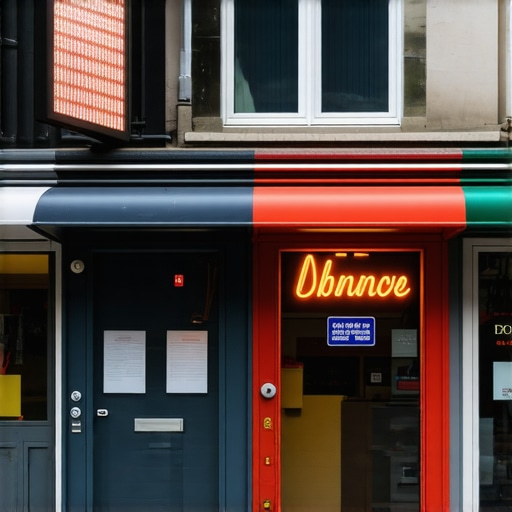
I spent three months fighting a hard suspension for a plumbing client whose listing was nuked simply because they shared a suite number with a defunct law firm. Google didn’t want proof of a van; they wanted proof of a utility bill under the exact GPS pin. This wasn’t just about an address. It was about proving the physical existence of a local entity within a spatial database that has grown increasingly hostile toward virtual offices. The plumbing listing remained dark for weeks until I personally visited the location. I took a photo of the exterior signage from across the street. I made sure to capture the street sign and the neighbor’s storefront in the same frame. That single image provided the geometric context the AI needed to verify the location. It proved the business wasn’t just a digital ghost or a service area business trying to game the system.
The physical reality of a digital pin
Google verification relies on permanent signage that proves a business operates from a specific GPS coordinate. Capturing the right angles reduces the chance of bot rejections. Professional gmb help often focuses on digital tweaks while overlooking the value of raw metadata in photos. The algorithm views your storefront as a proximity beacon. If the signal is weak, your ranking suffers. This isn’t just about showing a name on a door. It is about establishing a high trust score within the local search ecosystem. When you fail to provide the specific evidence needed to prove your storefront is real, the system assumes you are a map-spam entity. The shift toward video verification and live audits means the margin for error is gone. You are fighting a mathematical filter designed to prune anything that looks like a residential dwelling or a shared coworking desk without a dedicated lobby.
The wide angle street view proof
A successful verification photo must connect your business doors to the surrounding infrastructure. You need to stand across the street and capture the building in its entirety. This allows the AI to cross reference your image with existing Google Street View data. If the bot cannot align your photo with the known geometry of the neighborhood, it triggers a manual review loop. This is often why your google maps ranking fails without live video evidence or clear exterior context. The image must include the building number and the street name if possible. I have seen listings stuck in a suspension loop for months because the owner only provided close up shots of their logo. Google views close ups as easily faked. They want the grit. They want the sidewalk. They want the power lines. They want the neighbor’s sign. This spatial data proves the business is a permanent fixture of the local landscape. It is the foundation of your guide to google maps visibility and long term map pack stability.
“Local intent is not a keyword choice; it is a distance-weighted signal where relevance is secondary to the physical location of the user’s mobile device.” – Map Search Fundamental
The permanent mounting hardware close up
Google requires proof that your sign is not a temporary banner or a piece of paper taped to a window. You must photograph the mounting brackets and the texture of the sign itself. This demonstrates a financial investment in a physical location. Vinyl banners are the hallmark of temporary operations and spam. If you want to know the storefront signage rule most local businesses ignore during verification, it is the permanence factor. Take the photo at an angle that shows the depth of the sign. If it is a channel letter sign, show the wiring or the bolts. This microscopic detail signals to the investigator that this is a legitimate place of business. When we talk about mastering google maps ranking, we are talking about building a wall of evidence that an algorithm cannot ignore. A piece of foam board stuck to a door with duct tape will get you a permanent suspension for quality issues. Use high resolution images that show the grain of the wood or the metal of the frame.
Local Authority Reading List
- How to stop bot closures
- The physical proof checklist
- 7 Local proofs that work
- The utility bill variation that works
- Speeding up verification requests
The lobby directory and suite consistency
If your business is located inside a multi-tenant building, you must photograph the official building directory. Your business name and suite number must match your profile exactly. Any discrepancy will lead to a rejected verification request. The directory photo is a secondary trust signal. It proves the building management recognizes your tenancy. Many businesses fail because they use a suite number on Google but it is not listed on the physical directory in the lobby. This is a primary reason why using a shared office address destroys your map ranking and verification chances. You also need to photograph the suite number on your specific door. The door sign should be professionally made. If you are struggling with gmb help secrets, start with the physical reality of your hallway. The bot compares the text in your photo to the NAP data on your website and third-party citations. If the lobby says Suite 400 and your profile says Suite 400-B, the verification will stall.
The vehicle branding and physical tools
For service area businesses, the vehicle is your storefront. You must provide clear photos of the branded van or truck parked at your registered address. The branding must be permanent and not a magnetic sign. Magnetic signs are often rejected because they are easily transferred between vehicles. Google wants to see a wrapped vehicle or professionally painted decals. This is a core part of how to use local service areas to stop your map pin from being filtered. I often tell clients to photograph the vehicle with the door open, showing tools or equipment inside. This provides information gain that a simple exterior shot lacks. It proves you are a contractor and not a lead generation shell company. If you are wondering why your service area business listing is being filtered out, it is likely a lack of physical proof of operation. The vehicle photo should also include the license plate and the street address in the background to tie the two together.
“Relevance is secondary to the physical location of the user’s mobile device in distance-weighted signals.” – Local Search Intelligence Report
The utility bill overlay and GPS match
A photo of your official utility bill placed on your storefront counter is the ultimate verification proof. This connects the digital address to a financial document at the physical point of sale. The bill must be current and dated within 30 days. This is the strategy I used to fix the plumbing suspension mentioned earlier. We took a photo of the water bill sitting on the front desk with the storefront sign visible in the background. It is nearly impossible for a spammer to replicate this level of documentation. It is the one document gmb support always accepts for address changes and reinstatements. When the bot scans this photo, it extracts the address and the business name. It then cross-references this with the Google Business Profile data. This creates a high-trust link. If you are experiencing 3 quick fixes for a frozen google maps ranking, updating your photos with this level of detail is often the catalyst for a rank increase. It resolves the underlying trust issues that prevent the algorithm from pushing your pin into the top three results.