
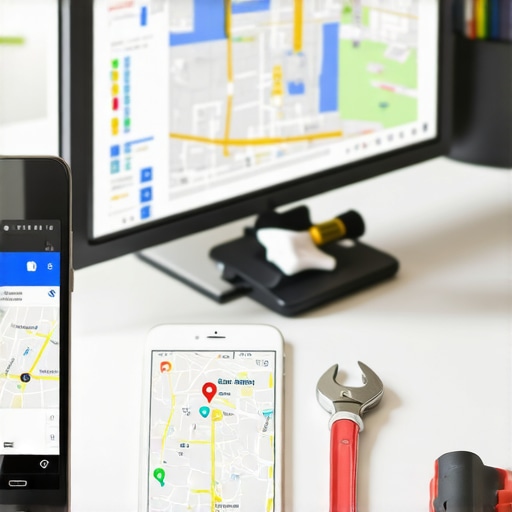
The ghost in the GPS coordinates
A frozen Google Maps ranking usually stems from a proximity filter or a data mismatch that creates a lack of trust in the local entity. Fixing a static position requires auditing the mathematical weight of local review sentiment and identifying if your business is caught in a proximity radius shift. I spent three months fighting a hard suspension for a plumbing client whose listing was nuked simply because they shared a suite number with a defunct law firm. Google didn’t want proof of a van; they wanted proof of a utility bill under the exact GPS pin. This is the reality of the hyper-local layer. The air smells like wet concrete after a rainstorm as I walk past storefronts, noticing the subtle glitches in their data. A misspelled street name on a single citation can act as a digital anchor. You are not just a business. You are a Proximity Beacon in a complex spatial database. If your ranking is stuck, the algorithm has likely decided your location lacks the salience to move closer to the centroid. This happens when the system detects a pattern that suggests you are an address rental or a keyword stuffed entity. I see these errors everywhere. The map pack is a dispatch system. If the dispatch logic fails to verify your physical existence, the pin stops moving. We must analyze the forensic trace of your service area polygon to find the break in the chain.
The three mile radius that determines your revenue
The proximity filter is a distance-weighted signal where relevance is secondary to the physical location of the user mobile device at the search moment. If you find your business stuck at the edge of the pack, it is often because of high proximity zones. This is where high proximity zones hurt your google maps ranking by filtering out redundant listings. You must understand the physics of a 3-mile radius shift. In high-density urban environments, the grid might even shrink to blocks. Centroid theory suggests that Google prefers the center of a city for general searches, but mobile behavior has shifted this to the user’s current GPS coordinates. When your ranking freezes, it is often because you have reached the limit of your current authority zone. To break this, you need to increase the density of your local signals. This involves more than just getting reviews. It requires generating offline behavior signals that prove you are a physical destination. The algorithm tracks the forensic trail of pings from mobile devices that actually enter your store. If the footfall data does not match your claimed popularity, the ranking stays frozen. This is a behavioral zooming mechanism. Google looks at how fast a user travels from their starting point to your pin. If that velocity is consistent, your trust score rises. If it is non-existent, you are just a ghost on a map. You might need seo support to audit these deep technical layers.
“Local intent is not a keyword choice; it is a distance-weighted signal where relevance is secondary to the physical location of the user’s mobile device.” – Map Search Fundamental
Local Authority Reading List
- Solving pending verification issues
- New evidence types for GMB
- Combating AI marketing bots
- Getting human help after AI denial
Why your physical address is a liability
A physical address becomes a liability when it is shared with competitors or located in a virtual office building that Google has flagged. The algorithm uses a filter called the Possum update logic to ensure variety in the search results. If two businesses in the same category share a building, one will almost always be filtered out. This is a common reason for a frozen ranking. You need gmb help to navigate these filters. I often see businesses using a P.O. Box or a UPS store. This is a death sentence for your visibility. Google wants to see a sign. They want to see the storefront. If you are stuck, check if your suite number is clearly defined in your NAP data across the web. Any inconsistency creates a trust gap. This gap acts as a ceiling for your google maps ranking. I recall a case where a locksmith was hidden for years because their address was technically an alleyway. The GPS pin was just slightly off the main road. Moving that pin twenty feet by submitting a suggest an edit fix with a photo of the front door was the only thing that worked. It was a simple glitch in the spatial data. Sometimes the system needs a manual nudge. You might find that duplicate listing tactics are necessary if a previous tenant never closed their profile. The map keeps records of every entity that ever lived at your address. If those ghosts are still active, your ranking will never budge. You must clear the digital debris.
The mathematical weight of local review sentiment
Review sentiment is now measured by the frequency of specific service keywords found within the text of the feedback rather than just the star rating. Google extracts entities from reviews to understand what you actually do. If you are a dentist but your reviews only mention the waiting room, you will not rank for root canal. This is a logical shift in how the algorithm perceives relevance. To unfreeze a ranking, you need reviews that mention your city and your specific services. This creates a stronger link between your location and the search query. Many people try to fake this. I can spot a fake review from a mile away. They lack the sensory details of a real customer. They don’t mention the squeaky door or the smell of the coffee. Google’s AI models are even better at this. They look for the VPN signature of the reviewer. If you are hit by a filter, you may need tactics to counter sabotage if a competitor is dropping fake negative feedback. The brand velocity of your reviews matters too. A sudden spike followed by silence is a red flag. You need a steady flow of interaction. This is why interaction velocity fixes are the new frontier for 2026. If the velocity stops, the ranking freezes. It is a simple conservation of momentum in the digital space. You should also consider how brand velocity acts as a ranking signal for your profile.
“Local businesses must provide evidence of physical existence that exceeds the digital footprint to maintain trust in an AI-dominated search environment.” – GMB Support Protocol 2025
The forensic trace of a service area polygon
Service area polygons must be defined by specific zip codes rather than a broad radius to avoid being flagged as a spammy or unrealistic coverage zone. If you claim to service an entire state from a small office, Google will freeze your ranking to protect the user experience. They want local relevance. You must be specific. Zoom into the neighborhoods you actually visit. Use the forensic trace of your actual work orders to define your area. I often find that businesses with frozen rankings have overlapping service areas with multiple other locations they own. This creates internal competition. Google does not know which pin to show, so it shows neither. You need local seo support to clean up these overlaps. Another factor is the JSON-LD LocalBusiness attributes. If your website schema does not match your GMB profile exactly, the data is seen as unreliable. I look for these mismatches like a photographer looking for a blur in the lens. A single digit difference in the phone number or a missing department name can cause a ranking to stall. You must ensure that your gmb optimization is perfectly synced with your site. If you have been hit by a filter shift, look for signs of filter shifts in your search console data. Often, a ranking drop is just the algorithm recalibrating the proximity weights for your industry. You might need to submit specific evidence files to prove your area of operation is legitimate. This is the only way to force a manual review when the automated systems get stuck in a loop.
The three manual ways to bypass ticket loops
Bypassing an AI support loop requires submitting secondary proof such as a live video walk through of the premises or a scanned business license. When you are stuck in a frozen ranking due to a technical glitch, the standard support forms are useless. You need to escalate. I have spent years learning how to bypass ai ticket loops. The first step is providing documentation that a bot cannot easily dismiss. This includes photos of your branded vehicle parked at the address with the street sign in the frame. These are the sensory anchors of the physical world. If you are denied, you need human gmb help. Do not just resubmit the same ticket. Change the evidence. Use documents that force a human review, like a utility bill that shows the same name and address as your listing. If your business pin is filtered out, check reasons your business pin is filtered out. It might be a simple category conflict. The algorithm is a machine. It follows a script. If your data doesn’t fit the script, the pin freezes. To move it, you have to change the data or the script. This is the core of the proximity engineer’s job. We find the friction and we remove it. Whether it is a vanishing ranking or a frozen one, the solution is always found in the physical reality of the business. Go outside. Take a photo of your building. Upload it. Sometimes, that is all it takes to unfreeze a year of stagnation. The map is just a reflection of the street. If the street changes, the map must follow eventually. Stop waiting for the algorithm to find you. Force it to look.
Comments are closed.